
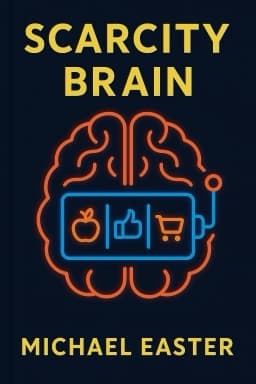
Why Your Brain is Hooked on Scarcity: The Hidden Loop Controlling Your Cravings
Discover the ancient brain circuit that explains why we crave more and how it shapes every aspect of modern life.
The Ancient Scarcity Loop: The Brain’s Survival Trick
Imagine a time when survival depended on persistence in the face of uncertainty. Our ancestors faced unpredictable food sources and harsh environments, which shaped a brain wired to seek rewards that were scarce and uncertain.
The Dopamine Dance: Why Uncertainty Feels So Good
What makes the scarcity loop so compelling is dopamine — often misunderstood as the pleasure chemical but more accurately the motivator for anticipation and craving. Studies with pigeons choosing between predictable and unpredictable rewards show a clear preference for uncertainty, even when it results in less food overall. This is because dopamine release peaks when rewards are uncertain, creating excitement and focus.
Scarcity Loop Everywhere: Technology, Media, and the Modern World
Today, the scarcity loop is embedded in our smartphones, apps, and media. Infinite scroll feeds, variable notifications, flash sales, and gamified health trackers all exploit this loop. Social media platforms magnify social status cues, driving users to seek likes and validation, which triggers dopamine surges and compulsive engagement. Even finance apps gamify trading, encouraging rapid, unpredictable wins and losses. Advertising leverages unpredictability to increase conversion rates dramatically. Recognizing this omnipresence helps us regain control by setting boundaries and cultivating mindfulness.
The Endless Appetite: Why More Feels Like Never Enough
Our craving for more extends beyond behavior into food and possessions. Evolution wired us to prefer calorie-dense foods and to accumulate resources as protection against scarcity. This is why many people overeat and why material accumulation is so common, despite abundance. Experiments show humans prefer adding to problems rather than subtracting, leading to complexity and overconsumption. This insatiable desire is a biological legacy clashing with modern abundance, often causing dissatisfaction and stress.
Breaking Free: Understanding Addiction and Choice
Addiction is often misunderstood as a disease or moral failing, but it is better seen as a learned behavior shaped by environment and choice. Studies show animals in enriched environments reduce addictive behaviors, and most people with addiction recover by their late 30s. The 'clinician’s illusion' biases us to believe addiction is always chronic because severe cases dominate clinical settings. Recognizing addiction’s behavioral nature empowers hope and practical recovery strategies, highlighting the role of motivation, social support, and environment.
Finding Balance in a World of Scarcity Brain
Understanding the scarcity loop is the first step towards balance. By recognizing how our brain craves unpredictability and more, we can cultivate mindfulness, simplify, and seek 'enough' rather than endless accumulation. Digital minimalism, selective consumption, and prioritizing meaningful social connections help mitigate the negative effects of the scarcity brain. This transformation from scarcity loops to abundance loops offers a hopeful path to mental well-being and fulfillment.
Want to explore more insights from this book?
Read the full book summary