
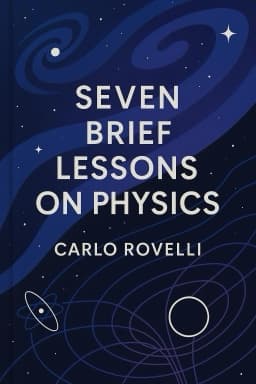
Unlocking the Universe: How Modern Physics Redefines Reality and Your Place in It
Dive deep into the revolutionary ideas that have transformed our understanding of the cosmos and discover how these insights resonate with our human experience.

From the Curved Fabric of Space-Time to the Quantum Grains of Reality
Imagine a universe where space and time are not fixed, absolute stages but dynamic, living fabrics that bend, twist, and ripple in response to the presence of matter and energy. This was the radical vision introduced by Einstein’s general theory of relativity, which transformed gravity from a mysterious force into the elegant curvature of space-time itself.
But the story of the universe’s fabric doesn’t end there. At scales unimaginably small, space itself is not smooth but granular, composed of tiny loops or 'atoms of space'—a concept emerging from the frontier of quantum gravity research. Time, too, loses its universal flow and emerges from the relationships between quantum events. This challenges our deepest intuitions and hints at a cosmos far more intricate than classical physics could imagine.
Quantum mechanics, born from the discovery that energy comes in discrete packets, reveals that particles like electrons don’t have fixed positions until observed. They exist as shimmering clouds of probability, making reality fundamentally uncertain and probabilistic. This quantum world underlies all matter, from the atoms in our bodies to the stars overhead.
Expanding our gaze, we see that humanity’s place in the cosmos has evolved dramatically—from ancient Earth-centered views to recognizing our solar system as a tiny part of a galaxy among billions, embedded in an expanding universe born from the Big Bang. This cosmic perspective evokes both humility and wonder.
The building blocks of matter—quarks, leptons, and force carriers—compose everything we know, yet the Standard Model that describes them remains incomplete, unable to explain dark matter or unify gravity with quantum mechanics. This puzzle drives ongoing research and fuels the quest for a deeper theory.
Time’s arrow—the distinction between past and future—emerges from heat and probability. Heat is the motion of molecules, and its flow from hot to cold is overwhelmingly probable, giving rise to irreversibility and the flow of time as we experience it. Even black holes, once thought eternal, emit faint thermal radiation, blending quantum mechanics, gravity, and thermodynamics into one profound mystery.
Reflecting on ourselves, we see consciousness as arising from complex information processing within the brain, with free will emerging from deterministic brain processes experienced subjectively as freedom. We are woven from the same cosmic threads as stars and trees, deeply connected to the universe around us.
Ultimately, this journey through modern physics is a celebration of human curiosity and the endless pursuit of knowledge. Science and myth intertwine, each nourishing our imagination and guiding us toward deeper truths. The horizon of understanding continually expands, inviting us all to explore, wonder, and dream.
May this glimpse into the cosmos inspire your own journey of discovery and awe at the magnificent universe we call home.
Want to explore more insights from this book?
Read the full book summary