
Unlocking the Power of Simple Rules: How to Master Complexity and Thrive in Chaos
Discover the secret weapon for navigating today’s complex world with ease and confidence.

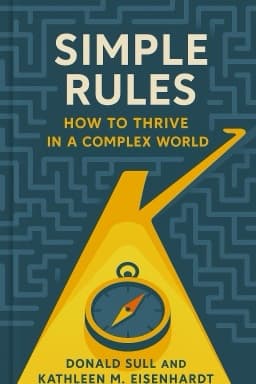
In an era defined by rapid change, technological disruption, and information overload, complexity can paralyze decision-making and sap organizational energy. Yet, as Donald Sull and Kathleen Eisenhardt compellingly argue in their book Simple Rules: How to Thrive in a Complex World, the antidote to complexity is not more rules or data but fewer, simpler rules that provide clarity and focus.
One of the book’s foundational insights is the role of simple rules in frontline medical triage during war. Medics use a handful of quick yes/no checks to prioritize care, decisions that save lives and reduce mortality rates dramatically over centuries. This example illustrates how simple rules act as mental shortcuts, allowing people to act decisively without paralysis by analysis. The authors categorize simple rules into types such as boundary rules (which set inclusion/exclusion criteria), prioritizing rules (which rank options), and stopping rules (which indicate when to quit or change course).
Beyond medicine, these rules manifest in business strategies, nature, and everyday life. For instance, judges use boundary rules to decide bail, burglars apply simple heuristics to avoid risk, and female crickets use stopping rules to optimize mate selection. Companies like Amazon and Cisco have thrived by identifying bottlenecks and applying simple prioritizing rules to focus resources effectively.
The book also highlights the importance of process rules—how-to, coordination, and timing rules—that guide effective action and collaboration. From forest firefighters lighting escape fires to starlings flying in murmuration, simple coordination rules enable complex group behavior without central control. Timing rules, like those used by Pixar for movie releases or insomnia sufferers managing sleep, create rhythms that enhance performance and well-being.
Crucially, simple rules are not static. They evolve through experience, scientific research, negotiation, and adaptation to new realities. The Jesuits’ rapid global expansion in the 16th century succeeded because their foundational document contained remarkably few but flexible rules, enabling innovation and adaptation. Similarly, disruptive innovation often requires breaking old rules and crafting new ones that better fit changed conditions, as seen in the Oakland Athletics’ analytics revolution in baseball.
However, simplicity faces barriers. Vested interests often benefit from complexity, and choice overload can paralyze action. The US tax code’s immense complexity and retirement plan participation challenges exemplify these obstacles. Overcoming them demands deliberate effort, stakeholder engagement, and persistence.
The authors provide a practical framework to develop and refine simple rules: clarify objectives, limit the number of rules to a manageable few, tailor them to context, and iterate based on feedback. This approach ensures rules remain relevant, actionable, and effective in guiding behavior.
Ultimately, Simple Rules offers a powerful paradigm for thriving amid complexity. By embracing clarity, focus, and adaptability, individuals and organizations can transform uncertainty into opportunity, coordinating collective action and fostering resilience. Whether you are a business leader, creative professional, or lifelong learner, the lessons of simple rules can illuminate your path to success.
Explore this transformative approach and unlock your potential to master complexity with confidence and grace.
Sources: Marketing Journal Review, Harvard Business Review, Jorge Arango’s Book Notes, Bookey Summary [[0]](#__0) [[1]](#__1) [[2]](#__2) [[3]](#__3)
Want to explore more insights from this book?
Read the full book summary