
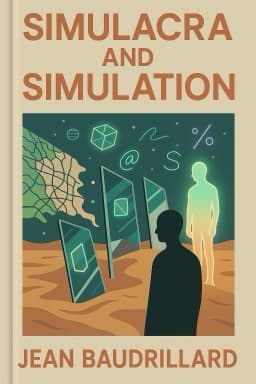
Is Reality Dead? How Simulacra and Simulation Are Shaping Our World
Unpacking the profound ideas of Jean Baudrillard about the disappearance of reality and the rise of hyperreal simulations.

In the late 20th century, a profound philosophical shift challenged the very notion of reality itself. Jean Baudrillard, a French sociologist and philosopher, introduced concepts that would radically alter how we perceive the world around us. His seminal work, Simulacra and Simulation, posits that in our contemporary era, reality has been supplanted by 'simulacra'—copies without originals—and that we exist within a hyperreal landscape where the distinction between the real and the imaginary has all but vanished.
The Precession of Simulacra
Baudrillard explains that in the past, representations or models were reflections of an original reality. However, today, these models precede and shape reality itself. This phenomenon is described as the 'precession of simulacra,' where the map no longer follows the territory but creates it. Imagine a world where your experience is shaped not by direct interaction but by images, media, and signs that have no grounding in an original truth. This inversion challenges traditional metaphysics and forces us to reconsider what we accept as 'real.'
The Implosion of Meaning in Media
Mass media plays a crucial role in this transformation. Instead of clarifying or deepening meaning, the overwhelming flood of information creates noise and neutralizes meaning. Media becomes a simulation machine, staging communication that often lacks authenticity. Social relations implode as people become passive consumers of spectacle rather than active participants in genuine community. This saturation leads to a paradox where more information results in less understanding.
Disneyland and the Imaginary
To illustrate hyperreality, Baudrillard famously uses the example of Disneyland. The theme park, designed as an imaginary space, actually serves to mask that the surrounding reality—the urban sprawl and consumer culture—is itself a simulation. Disneyland is a microcosm where childhood fantasies are recycled to sustain the illusion of reality, infantilizing adults and deterring awareness of the hyperreal condition.
Power and the Real
Despite the dominance of simulation, power structures cling to the notion of the 'real' to maintain control. However, parody and simulation erode the distinctions between submission and transgression, undermining the law and social order. This leads to a crisis of legitimacy where authority becomes a simulacrum, a hollow performance rather than genuine power.
Transparent Nihilism
Baudrillard identifies a shift in nihilism from violent rupture to a transparent, indifferent dissolution of meaning. This quiet nihilism aligns with systemic simulation, where melancholia and inertia reflect the loss of stakes and political vitality. Resistance becomes absorbed into the simulation, making authentic change difficult.
Surveillance and Media as DNA
The classic panopticon of centralized surveillance gives way to a networked system where observer and observed merge. Media functions metaphorically as DNA, programming social behavior and mutations at a fundamental level, creating a viral, omnipresent influence that shapes our reality.
Nuclear Simulation and Deterrence
The nuclear age exemplifies simulation through deterrence: the threat of destruction prevents actual conflict. This paradoxical peace is a spectacle of terror maintained by mutual assured destruction. The meticulous control in nuclear strategy mirrors societal regulation, emphasizing simulation’s reach into power and existence.
The Spiral of Negativity in Politics
Political discourses intertwine in endless loops, blurring oppositions and complicating power dynamics. Desire paradoxically fuels and is repressed by political systems, sustaining existing power while complicating revolutionary potential. This Möbius strip of politics reveals the complexity of power in a simulated world.
Beyond Simulation: Death and Renewal
Finally, Baudrillard offers a cyclical vision where the death of social and political realities may open pathways for new forms and hope. Despite the endurance of simulation, awareness and critical engagement offer possibilities for authentic renewal beyond the hyperreal.
Understanding these concepts helps us navigate a world where reality is no longer a given but a constructed, fragile simulation. It challenges us to seek deeper meaning and agency amid the spectacle.
Want to explore more insights from this book?
Read the full book summary