
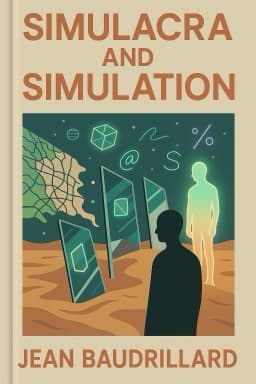
Politics in the Age of Simulation: The Möbius Strip of Power and Desire
How political power, desire, and discourse intertwine in endless loops that blur opposition and sustain the status quo.

Politics today can feel like an endless loop, a game where oppositions fold into each other and distinctions between authority and resistance blur. Jean Baudrillard uses the metaphor of the Möbius strip—a surface with only one side and one edge—to describe this spiral of negativity that entangles power, desire, and simulation.
The Möbius Compulsion
Political discourses combine and recombine in circular patterns, creating a compulsion where left and right, submission and transgression, are indistinguishable. This circularity erodes the clarity needed for genuine political action and complicates the landscape of power.
Desire’s Paradoxical Role
Desire is both the fuel that energizes political movements and the mechanism through which they are repressed. This ambiguity sustains the status quo by co-opting and neutralizing revolutionary impulses within the simulation.
Implications for Political Agency
Understanding this complex interplay invites critical reflection on political spectacle and media. It challenges us to recognize how simulation shapes perceptions of power and to seek new forms of engagement that can break the Möbius loop.
Hope Beyond the Spiral
While the spiral of negativity is daunting, awareness and creativity offer paths toward reimagined politics and social relations beyond simulation’s grip.
Want to explore more insights from this book?
Read the full book summary