
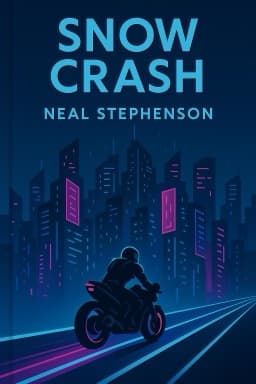
Why ‘Snow Crash’ Still Shapes Our Digital Dreams: The Wild Vision Behind the Metaverse
How a 1992 Novel Predicted—and Inspired—Our Online Realities

How a 1992 Novel Predicted—and Inspired—Our Online Realities
Imagine a world where the boundaries between physical and digital life have all but disappeared. In Neal Stephenson’s ‘Snow Crash,’ this world is the Metaverse: a neon-lit, endlessly creative virtual city where people work, play, and even fall in love as avatars. But what makes ‘Snow Crash’ so enduring isn’t just its dazzling world-building—it’s how eerily accurate its predictions have become.
Stephenson’s Metaverse anticipated the rise of virtual reality, online gaming, and digital economies decades before Facebook, Fortnite, or Roblox. Today, tech giants race to build their own Metaverses, using the very language Stephenson invented. But the novel is more than a tech prophecy; it’s a satire of corporate excess, a meditation on the power of language, and a warning about the dangers of digital addiction.
The story follows Hiro Protagonist—a hacker, swordsman, and pizza delivery driver for the Mafia—who uncovers a conspiracy involving a mind-altering virus that spreads through both code and language. Alongside Y.T., a fearless teenage courier, Hiro navigates a world where governments have collapsed and corporations rule. Their journey through the Metaverse is both thrilling and darkly funny, exposing the absurdities of a hyper-commercialized society.
What’s truly remarkable is how ‘Snow Crash’ foresaw the social aspects of digital life. Avatars signal status and identity, virtual clubs replace real-world gathering spots, and digital property is fiercely contested. The novel even predicts the rise of memes as viral ideas that shape culture and politics.
But ‘Snow Crash’ isn’t just a celebration of technology. It’s a cautionary tale about what happens when power is concentrated in the hands of a few, and when the lines between reality and simulation blur. Stephenson’s humor and optimism shine through, reminding us that even in a fractured world, community and creativity can flourish.
As we build our own Metaverses, the lessons of ‘Snow Crash’ are more relevant than ever. Will we create spaces of freedom and connection, or will we repeat the mistakes of Stephenson’s fractured America? The future, as the novel suggests, is up to us.
Read on to discover why ‘Snow Crash’ is still the wildest, smartest, and most important sci-fi novel for our digital age.
Want to explore more insights from this book?
Read the full book summary