
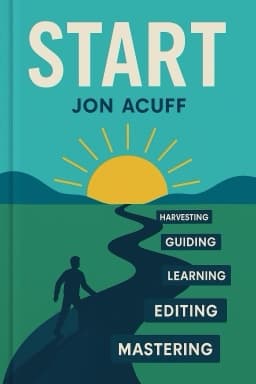
Why Fear is Your Greatest Ally: Lessons from Jon Acuff’s 'Start'
Understanding fear’s contradictory nature and harnessing it to fuel your dreams.

Fear is often seen as the villain in our stories of personal growth. But what if fear is actually trying to protect us, albeit in confusing ways? Jon Acuff’s book Start reveals fear’s schizophrenic nature — it shouts contradictory commands that can leave us frozen.
Fear tells you, "Don’t do it!" and then, "Do it all perfectly now!" These opposing commands create a mental tug-of-war, causing paralysis by analysis or overwhelm. Understanding this duality is crucial to overcoming fear’s hold.
Acuff encourages readers to acknowledge fear without letting it dictate their actions. Taking even tiny steps forward — starting small — is the key. For example, dedicating thirty minutes a week to a passion project can chip away at fear’s power. The early morning hours, when willpower is strongest, are an ideal time to act.
Psychological research supports Acuff’s insights. Studies show that fear activates both fight-or-flight responses and perfectionism tendencies, which can sabotage progress. However, consistent action builds confidence and rewires the brain’s fear responses.
Another powerful concept is embracing imperfection. Waiting for the perfect moment or flawless plan only strengthens fear’s grip. Instead, experimentation and learning through failure are essential. Each attempt, even if imperfect, is a victory over fear.
Fear also signals what matters most to us. Its presence highlights areas where growth is possible. By reframing fear as a guide rather than an obstacle, we can harness its energy to fuel our journeys.
In summary, fear is not your enemy but a complex ally. Recognizing its contradictory messages and choosing action anyway transforms fear from a barrier into a catalyst for growth and creativity.
Explore more about fear and motivation in Jon Acuff’s Start and related psychological insights from 1 and 2 .
Want to explore more insights from this book?
Read the full book summary