
Why the Modern World Is a Miracle (And Why We Might Lose It)
A Deep Dive into the Accidental Miracle That Changed Everything

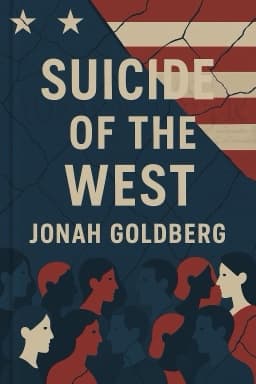
Imagine waking up in a world where the average person lives longer, healthier, and freer than the richest kings of centuries past. This isn’t a fantasy—it's the reality for billions today, and yet, as Jonah Goldberg warns in his provocative book Suicide of the West, this world is not natural or inevitable. For most of human history, poverty, violence, and tribalism were the norm. The sudden explosion of prosperity and liberty over the last three centuries—the so-called 'Miracle'—is an anomaly, a precious exception born of accidental cultural shifts in the West.
Goldberg’s argument is both comforting and chilling. Comforting, because it means progress is possible; chilling, because it means decline is always possible, too. He traces the roots of the Miracle to the Enlightenment, when new ideas about individual rights, the rule of law, and free markets began to take hold. These institutions unleashed human creativity and cooperation on a scale never seen before. But they are not self-sustaining. The tribal mind—our ancient programming—is always lurking, ready to reassert itself through populism, identity politics, and the seductive call of 'us versus them.'
Consider the example of property rights. For most of history, the strong took what they wanted, and the weak hoped for mercy. Only when rulers realized it was more profitable to protect property did the rule of law emerge. This was not out of altruism, but self-interest—a stationary bandit who found stability more lucrative than plunder. Over time, these pragmatic arrangements evolved into genuine institutions, but always remained fragile.
The Miracle is visible in the 'hockey stick' charts of economic growth and life expectancy. For thousands of years, progress was flat; then, suddenly, it soared. But as Goldberg and many historians remind us, this can be reversed. Civilizations have risen and fallen before, undone by complacency, corruption, and a loss of gratitude. Corruption, in its original sense, means rot or decay. Just as a house falls apart without care, so too do societies crumble when people forget the effort required to maintain them.
Today, the threats are both old and new. Populist leaders promise to restore greatness by demonizing outsiders. Identity politics reduces individuals to their group memberships, reviving tribal boundaries. Both undermine the pluralism and individual dignity at the heart of the Miracle. Goldberg urges us to remember that gratitude is not passive—it is an active defense against decline. Societies that teach gratitude for their institutions and freedoms are more resilient. Those that forget are vulnerable to cynicism and decay.
In the end, the Miracle of modernity is a gift, but also a responsibility. Each generation must choose to defend it, tell its story, and pass it on. Decline is not fate; it is a choice. The greatest danger is to forget how rare and precious our world truly is.
If we remember, if we teach, and if we remain vigilant, the Miracle can endure. But if we surrender to the tribal mind, we risk a darkness deeper than any we have known before.
Sources: Blinkist summary, Front Porch Republic review, NYMag review, Amazon reader reviews
1
2
4
3
Want to explore more insights from this book?
Read the full book summary