
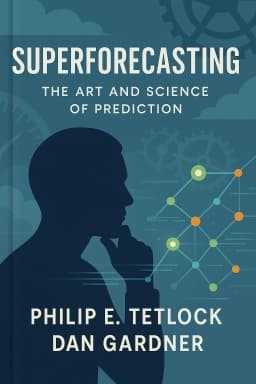
Inside the Mind of a Superforecaster: Psychology, Probability, and Problem Solving
How understanding your brain’s thinking systems can sharpen your predictions and decisions.

Our brains are marvels of evolution but not flawless machines. Understanding how we think is essential to improving our ability to predict the future. Dual-process theory reveals two cognitive systems: System 1, fast and intuitive, and System 2, slow and analytical.
System 1 delivers quick answers, often based on pattern recognition developed through experience. This intuition can be remarkably accurate in familiar domains. For example, a firefighter senses danger through subtle cues without conscious calculation.
However, intuition can also deceive. Our brains seek patterns even in random noise, leading to false positives and overinterpretation. This is why expert intuition is reliable only when grounded in valid feedback.
Superforecasters harness both systems. They respect gut feelings but verify them with deliberate analysis. They break complex questions into simpler parts, test assumptions, and balance the inside view (specific details) with the outside view (historical base rates).
Probabilistic thinking allows them to express uncertainty precisely and update beliefs incrementally as new data arrives, reflecting rational Bayesian reasoning.
By understanding and managing these mental processes, you can sharpen your judgment, avoid cognitive traps, and improve forecasting accuracy.
Sources: HowDo Summary, SoBrief Summary, Slate Star Codex Review
Want to explore more insights from this book?
Read the full book summary