
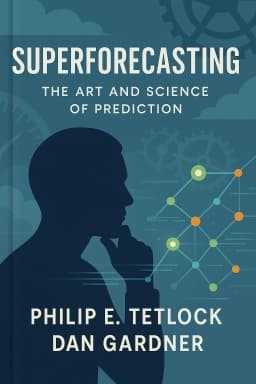
Unlocking the Secrets of Superforecasters: How Ordinary Minds Predict the Extraordinary
Discover how a small group of people defy odds to predict the future with uncanny precision—and how you can too.

Imagine standing at the edge of tomorrow, trying to peer through the fog of uncertainty. For decades, many believed the future was inherently unknowable, especially in complex domains like politics, economics, or global conflict. Yet recent research has shattered this fatalism, revealing a remarkable group of individuals known as superforecasters who consistently outperform experts and algorithms alike.
These superforecasters are not mystical seers. They come from all walks of life—retirees, scientists, artists, and professionals. What unites them is a set of thinking habits: intellectual humility, curiosity, openness to revising beliefs, and a disciplined approach to uncertainty. Unlike typical experts who often cling stubbornly to their views, superforecasters embrace doubt as a strength.
At the heart of their success is a deep understanding of how our minds work. Human thinking operates on two levels: a fast, intuitive System 1 that leaps to conclusions, and a slower, analytical System 2 that scrutinizes and refines. Superforecasters skillfully balance these systems, trusting intuition only when supported by evidence and engaging analytical thinking to challenge assumptions.
One of the biggest obstacles to accurate prediction is cognitive bias—mental shortcuts that simplify complexity but often mislead. For example, the "What You See Is All There Is" (WYSIATI) principle explains why we tend to overconfidently make judgments based only on available information, ignoring what we don't know. Superforecasters combat this by deliberately seeking missing information and considering alternative scenarios.
Measurement is another cornerstone of improvement. Forecasting must be precise, with clear definitions and timelines, to evaluate success meaningfully. Tools like the Brier score quantify how close forecast probabilities are to actual outcomes, enabling forecasters to learn from mistakes and refine their methods.
Breaking down complex questions into smaller, manageable parts—known as problem decomposition—is a powerful technique used by superforecasters. This approach, combined with balancing the inside view (case specifics) and outside view (historical base rates), grounds predictions in reality while accounting for unique factors.
Probabilistic thinking transforms forecasting from guesswork into a science. Instead of binary yes/no answers, assigning probabilities captures uncertainty and guides better decisions. Superforecasters continuously update their beliefs incrementally as new information arises, reflecting rational Bayesian updating.
Collaboration magnifies forecasting skill. Diverse teams, fostering psychological safety and constructive disagreement, outperform individuals by pooling knowledge and challenging blind spots. This collective intelligence is greater than the sum of its parts.
Finally, these lessons extend beyond forecasting to leadership and decision-making. Effective leaders balance decisiveness with humility, empower others, and embrace uncertainty wisely. The future of forecasting lies in human-machine collaboration, combining computational power with human judgment.
By adopting the mindset and methods of superforecasters, anyone can improve their ability to anticipate the future, navigate complexity, and make sound decisions in an uncertain world.
Sources: HowDo Summary, SoBrief Summary, Slate Star Codex Review
Want to explore more insights from this book?
Read the full book summary