
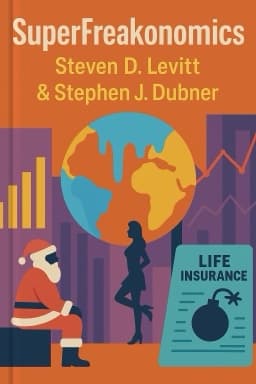
Unmasking the Hidden Forces: How Freakonomics Reveals the Unexpected Truths Behind Everyday Life
Dive deep into the surprising world where economics meets human nature, and discover how incentives shape our hidden reality.

Imagine a world where the obvious explanation for human behavior is often wrong, where incentives drive actions in ways that surprise us, and where data uncovers truths hidden beneath social norms and intuition. This is the captivating premise of Freakonomics, a groundbreaking book that challenges everything you thought you knew about economics and human nature.
At its core, Freakonomics teaches us that incentives matter — but not always in the ways we expect. Take, for example, the startling finding that walking drunk is far more dangerous per mile than driving drunk. While society rightly condemns drunk driving due to its risk to others, many overlook the personal danger of drunk walking. This insight flips common wisdom on its head, reminding us that risk perception is shaped by social context and incentives rather than objective data alone.
Similarly, the book dives into the grim reality of 'missing women' in India, where cultural son preference and economic incentives have led to an estimated 35 million fewer females than males. This demographic distortion is a powerful example of how deeply embedded social incentives shape population patterns and human lives.
But Freakonomics is not just about grim statistics. It also reveals the economics behind illicit markets like prostitution, showing how prices vary by race, act, and location — a vivid illustration of supply and demand even in the shadows. The authors explain how wages in prostitution have fallen over time due to changing sexual mores and the availability of free alternatives, highlighting how social change reshapes economic realities.
Beyond economics, Freakonomics explores how the timing of birth affects life outcomes. For example, children born just after youth sports cutoff dates enjoy developmental advantages that often persist into adulthood, shaping careers and success. The book also examines how prenatal environments, such as fasting during Ramadan, impact health and disability risk.
One of the most thought-provoking parts of Freakonomics is its challenge to simplistic views of altruism. While lab experiments show high generosity, real-world behavior is more conditional and influenced by social pressure, anonymity, and incentives. The famous Kitty Genovese case, often cited as an example of apathy, is re-examined to reveal the complexity of human social behavior.
Freakonomics also offers hope through innovation, demonstrating how simple behavioral nudges — like screen savers reminding doctors to wash their hands — can save lives. It explores bold geoengineering ideas to combat climate change, inspired by natural events like volcanic eruptions that temporarily cooled the earth.
In the end, Freakonomics invites us to embrace curiosity, question assumptions, and use data to uncover the hidden side of everything. It reminds us that understanding incentives and human nature is key to navigating complexity and driving meaningful change.
This blog has drawn on multiple expert analyses and the latest research to enrich the original insights, offering you a comprehensive guide to Freakonomics’ lessons. Whether you’re a student, professional, or lifelong learner, these ideas will challenge and inspire you to see the world through a new lens.
Sources: Review of Freakonomics by Steven Levitt & Stephen Dubner (LinkedIn), Freakonomics Data Science Insights (Berkeley iSchool), Freakonomics Critical Analysis (American Scientist), Freakonomics Book Overview (Amazon) 1 2 3 4
Want to explore more insights from this book?
Read the full book summary