
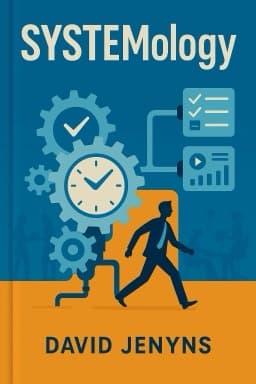
Why Most Business Owners Stay Trapped (And How SYSTEMology Sets Them Free)
Discover the hidden traps of entrepreneurship and how SYSTEMology's approach can unlock your time, profits, and peace of mind.
Every entrepreneur dreams of freedom: the ability to work when and where they want, to earn more by doing less, and to see their business thrive without their constant presence. Yet, the harsh reality is that most small business owners become their company’s biggest bottleneck. They work longer hours than ever, miss out on family moments, and live with the constant anxiety that if they step away—even for a day—everything will collapse.
This is what David Jenyns calls the 'owner trap' in his book SYSTEMology. It’s a silent epidemic affecting businesses worldwide, regardless of industry or business model. Owners become the hub of every wheel, the answer to every problem, and the single point of failure. But why does this happen? And, more importantly, how can you escape?
Jenyns shares his own story: after years of building a successful digital marketing agency, he realized the business he’d created was running him—not the other way around. The turning point came with the birth of his first child, forcing him to confront the reality that he couldn’t keep living in firefighting mode. He needed a business that could function independently, allowing him to be present for his family and pursue new opportunities. This personal crisis led to the creation of the SYSTEMology framework—a practical, no-nonsense approach to business systemization designed for real-world entrepreneurs, not corporate giants.
The core insight of SYSTEMology is that systemization isn’t about documenting everything or creating mountains of SOPs. Instead, it’s about identifying and systemizing the 10 to 15 core processes that drive 80% of your business’s results—the so-called 'critical few.' Jenyns introduces the concept of the Critical Client Flow (CCF), a simple mapping exercise that helps owners pinpoint the key steps from lead generation to client delivery. By focusing on these, you can eliminate the chaos and create consistency where it matters most.
But here’s the twist: the owner should not be the chief system builder. In fact, Jenyns argues, owners are often the worst people to document systems because they’re too busy, too close to the work, or too perfectionistic. The real experts are your team members—the ones who do the work every day and know the shortcuts, pitfalls, and best practices. SYSTEMology teaches you how to empower these 'knowledgeable workers' to capture their processes, supported by a 'systems champion' who loves organizing information.
With this approach, systemization becomes fast, collaborative, and sustainable. You don’t need to be a systems guru. You just need to get out of your own way, trust your team, and focus on progress over perfection. The results? More time, fewer errors, and a business that can grow—or even be sold—without you as the bottleneck.
The SYSTEMology method has helped hundreds of businesses escape the owner trap, from agencies and consultancies to trades and retail. The book is filled with real case studies, practical templates, and a step-by-step roadmap that anyone can follow. If you’re tired of being your business’s biggest bottleneck, SYSTEMology offers a proven path to freedom, profit, and peace of mind.
References: SYSTEMology book by David Jenyns, Blinkist summary, Readingraphics summary.
1
2
Want to explore more insights from this book?
Read the full book summary