
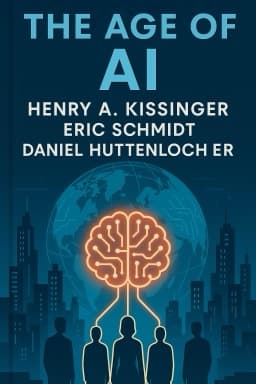
Why 'The Age of AI' Will Change How You See the Future — And Yourself
Discover the profound insights from 'The Age of AI' that challenge everything you thought you knew about intelligence, knowledge, and human identity.

Artificial intelligence is no longer a distant dream or a sci-fi fantasy; it is the defining technology of our age.
The Dawn of New Intelligence
One of the most striking revelations is how AI reveals aspects of reality inaccessible to human cognition. Consider AlphaZero, an AI that mastered chess in just four hours of self-play, developing strategies never seen before. Or the discovery of a new antibiotic, halicin, identified by AI analyzing tens of thousands of molecules—a task impossible for human researchers alone.
The Evolution of Reason and Knowledge
Tracing human reason from Plato’s allegory of the cave through Kant’s reflections on the limits of understanding, the book situates AI as the next step in this intellectual journey. The printing press and digital revolutions democratized knowledge, but AI now accelerates and deepens our grasp of complex realities.
Machine Learning: Teaching Machines to Learn
Unlike early AI that relied on fixed rules, modern AI learns from data, inspired by the brain’s neural networks. Deep learning enables machines to recognize patterns and generate new content, from art to language, raising questions about creativity and authorship.
Network Platforms and Societal Influence
AI powers vast network platforms that connect billions, shaping what we see, buy, and believe. These platforms grow more valuable as users join, but also pose challenges like content moderation at scale and the rise of misinformation.
Security and the New World Order
AI’s integration into military systems and cyber warfare disrupts traditional concepts of defense and deterrence. Autonomous weapons and anonymous cyber attacks raise ethical and strategic dilemmas.
Redefining Human Identity
As AI companions and creative systems become commonplace, our notions of uniqueness and autonomy evolve. Personalized AI interactions influence social bonds and emotional development, while AI-generated art challenges the boundaries of human creativity.
AI as a New Lens on Knowledge
AI accelerates scientific breakthroughs by uncovering patterns beyond human comprehension, reshaping epistemology itself. The book urges us to reconsider how we validate knowledge when AI’s internal logic is opaque yet powerful.
Information, Influence, and Society
AI shapes political discourse and public opinion through personalized content, creating echo chambers and spreading disinformation. The blog stresses the need for transparency, media literacy, and policy to safeguard democratic processes.
Ethical Imperatives and Human Agency
Finally, the authors remind us that AI lacks intrinsic morality; humans must actively guide its development with ethical frameworks, transparency, and inclusive dialogue.
In sum, 'The Age of AI' offers a profound meditation on technology’s promise and peril. It challenges us to rethink knowledge, identity, and governance in a world where machines think — not like us, but alongside us.
Whether you are a technologist, philosopher, policymaker, or curious reader, this book is a must-read to understand the unfolding AI revolution and your role within it.
Sources: Insights synthesized from 'The Age of AI' and reviews on Blinkist, Amazon, Instaread 1 2 4
Want to explore more insights from this book?
Read the full book summary