
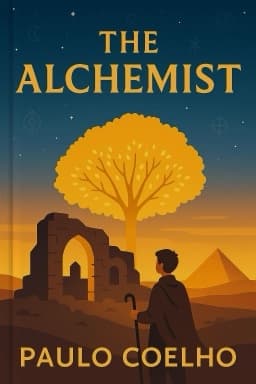
Beyond the Treasure: Spiritual Alchemy and the Art of Self-Transformation in 'The Alchemist'
Explore the mystical symbolism of alchemy and how it reflects our inner spiritual journey toward wholeness.

Alchemy, an ancient practice shrouded in mystery, sought to transmute ordinary metals into gold. Yet, in Paulo Coelho's 'The Alchemist,' this process takes on a deeply spiritual meaning — a metaphor for the transformation of the self.
At its core, spiritual alchemy involves shedding the layers of fear, doubt, and limitation that obscure our true nature. Santiago’s encounters with the alchemist demonstrate that transformation requires not only knowledge but also faith — faith in the journey, in the universe, and in oneself.
The alchemist teaches that courage is the key to unlocking the 'Language of the World,' the universal communication that connects all beings. Without courage, the soul remains closed, unable to perceive the omens and signs that guide us toward our Personal Legend.
Fear, often the greatest obstacle, is confronted head-on in the desert’s harsh trials. These moments symbolize the crucible in which the soul is refined, much like base metals heated and purified in alchemical vessels.
This spiritual alchemy is not a solitary endeavor. The presence of mentors, the support of love, and the recognition of the universal language all weave together to facilitate transformation. The journey is as much about connection as it is about individual growth.
Applying these insights to our own lives invites us to see challenges as opportunities for growth, to trust in the signs that appear, and to cultivate the courage necessary for change. The alchemical metaphor reminds us that true wealth is not material but the richness of a transformed soul.
Ultimately, 'The Alchemist' offers a blueprint for self-transformation, encouraging us to turn our own leaden experiences into golden wisdom. It is a call to embrace the unknown with faith, to listen to the language of the world, and to awaken to the infinite potential within.
Want to explore more insights from this book?
Read the full book summary