
Teaching AI Our Values: The Art and Science of Alignment Through Imitation and Inference
How can machines learn what we truly value? Exploring the cutting-edge methods that bring AI closer to human norms.

Imitation Learning: Learning by Watching
Just as children learn by observing adults, AI can acquire complex behaviors by watching demonstrations. This approach, known as imitation learning or behavioral cloning, allows machines to replicate socially acceptable and practical skills without explicit programming. It bridges the gap between raw capability and normative behavior.
Inverse Reinforcement Learning: Inferring Intentions
Humans often act with implicit goals rather than explicit instructions. Inverse reinforcement learning (IRL) enables AI to deduce these underlying objectives by analyzing observed behaviors. Instead of being told what to optimize, machines learn what humans value by inference, a critical step toward nuanced alignment.
Managing Uncertainty: Safe Decisions in an Ambiguous World
The real world is full of incomplete and ambiguous information. AI must navigate this uncertainty to make reliable decisions. Probabilistic models and Bayesian reasoning provide frameworks for quantifying and managing uncertainty, enhancing safety and trustworthiness.
Challenges and the Road Ahead
While promising, these methods face hurdles such as the complexity of human values, the risk of misinterpretation, and computational demands. Ongoing interdisciplinary research and ethical reflection are essential.
Conclusion
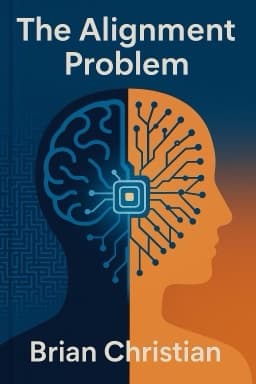
Imitation, inference, and uncertainty management form a triad guiding AI toward normative alignment. As Brian Christian’s "The Alignment Problem" shows, this journey is both a technical challenge and a profoundly human endeavor.
Want to explore more insights from this book?
Read the full book summary