
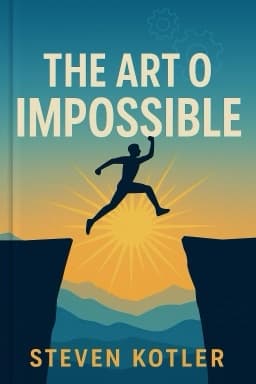
Unlocking the Impossible: How Steven Kotler’s Blueprint Can Transform Your Life
Discover the science-backed steps to achieving what you once thought impossible.

Imagine waking up each day with a deep, burning sense of purpose, a clear vision for your future, and the tools to bring your most ambitious dreams to life. This isn’t fantasy—this is the promise at the heart of Steven Kotler’s groundbreaking book, The Art of Impossible. By weaving together decades of scientific research and real-world examples, Kotler reveals how anyone, regardless of background or resources, can consistently achieve the extraordinary.
The book is built on four foundational pillars: motivation, learning, creativity, and flow. Kotler begins with motivation, introducing the concept of the intrinsic motivation stack: curiosity feeds passion, passion fuels purpose, purpose demands autonomy, and autonomy drives mastery. Each layer is supported by neuroscience, showing how our brains are wired for growth and achievement when the right triggers are in place.
Next, Kotler tackles learning, advocating for a growth mindset and rigorous truth filters. He suggests immersing yourself in five foundational books on any subject and seeking out diverse expert opinions to avoid bias. This approach, he argues, accelerates mastery and keeps you grounded in reality.
Creativity, the third pillar, is demystified as a skill that can be systematically developed. Kotler highlights the importance of pattern recognition, playful experimentation, and the incubation effect—letting ideas marinate in the subconscious. Many breakthroughs, he notes, happen not in moments of intense focus, but during periods of rest and play.
The final and perhaps most coveted state is flow. Kotler calls flow the 'source code of ultimate human performance,' a state where time slows, self-doubt vanishes, and productivity skyrockets. He outlines 22 triggers for flow, from clear goals and immediate feedback to the right balance of challenge and skill. Flow, he asserts, is not just for athletes or artists but is accessible in daily life—at work, in relationships, and even in mundane tasks.
But Kotler is quick to remind us that peak performance is cyclical, not constant. The flow cycle—struggle, release, flow, recovery—must be honored. Rest and active recovery are not luxuries but necessities for sustained excellence. In the end, Kotler’s message is clear: the art of impossible is really the art of becoming—again and again, through curiosity, grit, learning, creativity, and flow. The journey is infinite, and the only way to lose is to stop playing.
Whether you’re an entrepreneur, athlete, artist, or lifelong learner, The Art of Impossible offers a science-backed, actionable blueprint for turning your biggest dreams into reality. The impossible, Kotler insists, is always just the beginning. 2 3
Want to explore more insights from this book?
Read the full book summary