
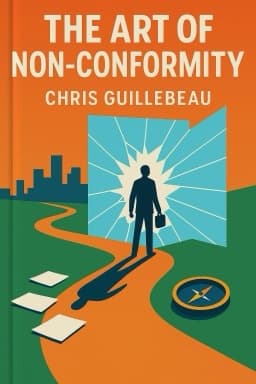
7 Surprising Lessons from ‘The Art of Non-Conformity’ That Will Change How You See Success
How to Break Free from the Ordinary and Rewrite Your Own Rules

How to Break Free from the Ordinary and Rewrite Your Own Rules
If you’ve ever felt restless in a world that rewards conformity, Chris Guillebeau’s ‘The Art of Non-Conformity’ is your permission slip to live differently. This book isn’t just a call to rebel for rebellion’s sake—it’s a roadmap for creating a life that is uniquely yours, filled with meaning, adventure, and genuine achievement. In this post, I’m sharing seven transformative lessons from the book that can help you challenge the status quo, redefine success, and start living with intention.
1. Question Everything—Especially the Rules
From a young age, we’re taught to follow rules: go to school, get a job, climb the ladder. But Guillebeau argues that most rules are arbitrary, designed to maintain systems rather than foster individual growth. He shares stories of people who questioned why things had to be a certain way and found new paths as a result. The first step to non-conformity is simple but profound: ask ‘Why?’ and don’t settle for ‘Because that’s how it’s always been.’
2. Success Is Personal—Define It for Yourself
Traditional success—money, titles, approval—is often a mirage. The book encourages you to write your own definition of success, one that aligns with your values and passions. Whether it’s traveling the world, starting a nonprofit, or simply having more time for family, your goals are valid even if they don’t fit the mold. Guillebeau’s own journey—visiting every country on earth—shows that big dreams are possible when you define them yourself.
He introduces the concept of the 'life list,' a set of radical, personal goals that serve as a compass for decision-making. Writing these down isn’t just wishful thinking; it’s a proven way to accelerate achievement and clarity.
2
3
3. Fear Is a Signal, Not a Stop Sign
Fear is universal, especially when you step outside the norm. Guillebeau reframes fear as a sign that something matters, not a reason to quit. He recommends writing down your fears, imagining the worst-case scenario, and then taking small actions anyway. The result? Confidence grows with every step you take, and the wall of fear gets weaker over time. Action, not overthinking, is the antidote to anxiety.
4. Build Skills, Not Just Resumes
In a world of layoffs and automation, job titles are fragile—but your skills are forever. The book urges readers to focus on competence: What can you do that creates value? How can you keep learning and adapting? Many of the most successful non-conformists started with side projects, not grand gestures. These experiments are safe spaces to fail, learn, and eventually thrive.
5. Education Is Everywhere—Design Your Own Curriculum
Formal education is valuable, but it’s not the only way to learn. Guillebeau describes how you can create your own 'graduate program' with books, travel, volunteering, and real-world projects—often for less than the cost of a semester at university. The key is to focus on impact: What can you do with what you learn? Real-world results matter more than credentials.
6. Challenge Authority—Creativity Wins Over Compliance
Gatekeepers and bureaucrats love to say 'no.' But the book is filled with stories of people who found creative ways around obstacles, from disrupting unfair auctions to turning job interviews upside down. When you change the rules, you change the odds. Morality and legality aren’t always aligned, so trust your sense of justice and don’t wait for permission to make a difference.
7. Legacy Is Built in Small Steps—Serve Others, Not Just Yourself
The final lesson is about legacy. The most meaningful lives are those that blend personal ambition with service to others. Movements and big changes almost always start with a 'small army'—a handful of committed allies. Generosity multiplies opportunities, and your legacy is written in the lives you touch and the problems you help solve.
Final Thoughts
‘The Art of Non-Conformity’ is a call to action for anyone who feels out of place in a world that rewards sameness. These seven lessons show that you don’t need to ask for permission to live a remarkable life. Question, define, act, learn, create, and serve. The world needs your unique gifts—go forth and leave your mark.
References:
2
3
4
Want to explore more insights from this book?
Read the full book summary