
The Hidden Power of Bayesian Thinking: How This Book Transforms Your Perspective
Learn how Bayesian methods revolutionize the way we update our knowledge with new evidence.

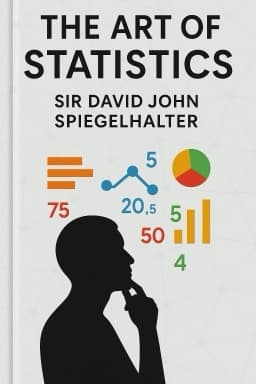
Imagine constantly updating your beliefs as new information arrives, much like adjusting your estimate of the weather based on morning clouds and evening forecasts. This dynamic learning process is at the heart of Bayesian statistics, a theme beautifully explored in 'The Art of Statistics.'
Bayes’ theorem provides a mathematical rule to combine prior knowledge with new data, yielding updated probabilities called posterior distributions. This approach mirrors how humans naturally learn and revise beliefs.
In forensic science, likelihood ratios quantify how strongly evidence supports one hypothesis over another, helping courts evaluate DNA matches objectively. The book highlights how Bayesian thinking enhances fairness and clarity in legal decisions.
Hierarchical Bayesian models extend this framework by borrowing strength across related groups to improve estimates, especially when data are sparse. This has improved election polling accuracy and disease mapping, demonstrating practical impact.
Bayesian methods embrace uncertainty rather than ignoring it, promoting continuous learning and adaptation. This perspective shifts statistics from static calculation to a living, evolving discipline.
By adopting Bayesian thinking, we gain a powerful lens to interpret data, update knowledge, and make better decisions in a complex world.
Want to explore more insights from this book?
Read the full book summary