
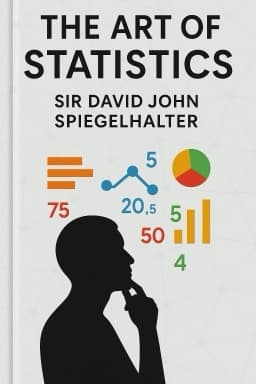
Why Most People Get Statistics Wrong — And How This Book Fixes It
Break free from confusion and learn to think statistically with clarity and confidence.

Statistics can seem like a foreign language full of confusing terms and counterintuitive ideas. Many people fall prey to common mistakes: mistaking correlation for causation, misreading confidence intervals, or overvaluing P-values.
'The Art of Statistics' tackles these challenges with clarity and compassion. It explains that correlation simply means two variables move together, but one does not necessarily cause the other. Establishing causation requires carefully designed studies like randomized controlled trials, which balance confounding factors and provide stronger evidence.
Confidence intervals are often misunderstood as probabilities about a single estimate, but they actually describe the long-run performance of estimation methods. Similarly, P-values are frequently misinterpreted as the chance that a hypothesis is true, rather than the probability of observing data assuming the null hypothesis is true.
The book also exposes questionable research practices like P-hacking — manipulating analyses until significant results appear — and selective reporting, which inflate false positive rates and undermine trust. Transparency, pre-registration of studies, and sharing data openly are essential to improve scientific reliability.
By learning to think statistically, we gain tools to critically evaluate claims, avoid being misled, and participate more fully in informed decision-making. This book is a vital guide for anyone seeking to navigate the complexities of data with confidence and insight.
Breaking free from confusion, we embrace statistics as a tool for clarity and wisdom, not fear or mystification.
Want to explore more insights from this book?
Read the full book summary