
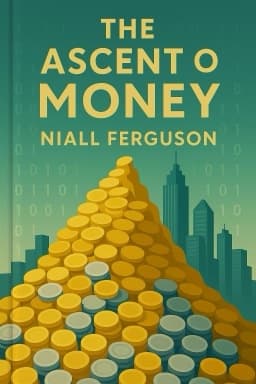
The Ascent of Money: How Money Shaped Our World and Why You Should Care
Discover the riveting journey of money from ancient clay tablets to modern digital currencies and why understanding this history is key to mastering your financial future.

Money is more than coins or paper—it's the lifeblood of civilization, a complex web of trust, innovation, and human behavior that has evolved over thousands of years. In 'The Ascent of Money,' Niall Ferguson takes us on a sweeping journey from the earliest clay tablets used in Mesopotamia to the dizzying heights of 21st-century global finance. Understanding this history is not just academic; it offers vital lessons for anyone navigating the modern economic landscape.
Imagine ancient traders recording debts on clay tablets, not unlike today's digital contracts. These early financial instruments laid the groundwork for credit systems that allowed societies to grow beyond simple barter. Fast forward to Renaissance Italy, where banking emerged amidst cultural taboos against usury. Jewish moneylenders in Venetian ghettos and the Medici family’s innovative decentralized banking partnerships revolutionized finance, enabling commerce and political power to flourish.
Government bonds soon became crucial tools for financing wars and shaping empires. Florence's 'mountain of debt' and Venice’s tradable prestiti bonds bound citizens to their states financially, while the Rothschild family's international network demonstrated how capital and information could shift geopolitical balances. This era reveals how finance intertwines with power and society.
The stock market introduced a new dimension—human emotion. The Dutch East India Company's pioneering issuance of tradable shares gave birth to stock markets, but also to bubbles driven by herd mentality and speculation. Episodes like John Law’s Mississippi Bubble show how exuberance can inflate prices beyond reason, only for reality to bring painful corrections. Behavioral finance today still grapples with these timeless psychological forces.
Insurance emerged as a way to manage risk, from marine insurance protecting merchants at sea to social welfare programs safeguarding workers. Innovations like catastrophe bonds demonstrate ongoing efforts to tame uncertainty in a complex world. These mechanisms stabilize economies and enable growth despite life’s unpredictability.
The 20th century saw mortgage finance transform real estate into a key asset class, fueling homeownership but also systemic vulnerabilities. The 2007-2008 crisis starkly illustrated the dangers of excessive credit and securitized debt. Real estate remains deeply tied to personal wealth, making its cycles impactful far beyond the market.
Global finance now knits nations together in unprecedented ways. The symbiotic relationship between China and America, dubbed 'Chimerica,' alongside the rise of sovereign wealth funds, shapes capital flows and geopolitics. While globalization offers growth, it also spreads risks rapidly, demanding new forms of regulation and cooperation.
Ultimately, the ascent of money is a story of trust, innovation, and human nature. Financial crises, while painful, act as catalysts for evolution. Improving financial literacy is essential to empower individuals and societies alike. By embracing this rich history and its lessons, we can better navigate the challenges and opportunities ahead.
Money is not just an economic tool—it is a mirror reflecting our collective hopes, fears, and ingenuity. Understanding its ascent equips us to build a more stable and prosperous future.
Want to explore more insights from this book?
Read the full book summary