
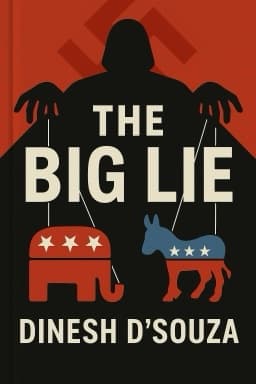
The Shocking Truth Behind 'The Big Lie': How History and Politics Are Twisted
Unmasking the Deception: A Deep Dive into the Psychological and Historical Roots of Political Lies

In an age dominated by information overload and relentless political rhetoric, discerning truth from deception has become a formidable challenge. At the heart of this confusion lies a powerful psychological weapon known as the 'big lie' — a propaganda technique that flips reality on its head, blaming victims and portraying perpetrators as heroes. This blog unpacks this phenomenon, revealing how it distorts our understanding of history and politics.
The 'big lie' operates by embedding a colossal falsehood so outrageous that people cannot believe it to be untrue. Originating from a paradoxical usage by a notorious dictator who accused others of the very lies he propagated, this tactic exploits psychological transference to shift blame and justify oppression. In politics, it manifests as accusations of fascism and Nazism hurled at conservatives by those who embody those very tactics — censorship, intimidation, and propaganda.
Understanding this inversion is crucial. It reveals how victim and perpetrator roles are manipulated to confuse public discourse and silence opposition. This mechanism is not merely theoretical; it has real-world consequences, shaping policies and societal attitudes.
Falsifying History: The Left-Right Distortion
The political terms 'Left' and 'Right' originated during the French Revolution, representing opposing visions: conservatives preserving monarchy and church, and revolutionaries pushing change. However, in the American context, these terms have evolved uniquely. Conservatives seek to uphold the revolutionary ideals of freedom and limited government, while the Left pursues expanding centralized control over economy and culture.
A deliberate falsification of history has obscured the true nature of fascism and Nazism, which emerged from revolutionary socialism and collectivism, not conservatism. Leading fascist philosophers were socialists aiming to reshape society through a collectivist state. This historical distortion serves contemporary political narratives, mislabeling fascism as a right-wing ideology to deflect attention from authoritarian tendencies within the Left.
Mussolini’s Journey: From Marxist to Fascist
Benito Mussolini, the founder of fascism, began his political life as a committed Marxist socialist. He edited socialist newspapers and organized workers’ strikes, deeply embedded in socialist activism. Fascism was not a betrayal but a radical evolution within socialism, integrating nationalism and collectivism into a new revolutionary vision. This challenges the simplistic left-right dichotomy and reveals fascism’s roots in socialist thought.
The Democratic Party’s Historical Parallels with Fascism and Nazism
The Democratic Party’s history includes support for slavery, segregation, and opposition to civil rights, with the Ku Klux Klan acting as a domestic terrorist arm enforcing white supremacy. These racial terrorism tactics bear disturbing parallels to fascist racial policies. Forced labor systems and genocidal practices in American history resemble Nazi concentration camps in their brutality and dehumanization, revealing uncomfortable continuities in political ideology and practice.
Franklin D. Roosevelt: The American Führer?
Franklin D. Roosevelt’s New Deal expanded federal government control over the economy through corporatist policies resembling Italian fascism. Mussolini admired FDR’s vision, praising him as a fellow fascist. The New Deal’s public works, regulatory expansion, and authoritarian tendencies challenged liberal ideals and aligned with fascist models of economic planning and state intervention.
The Left’s Cultural Hegemony: Modern Gleichschaltung
The modern Left’s dominance over academia, media, and Hollywood enforces ideological conformity through a cultural hegemony reminiscent of the Nazi policy of Gleichschaltung. This control suppresses dissent, marginalizes conservatives, and narrows public discourse. Social media censorship, protests, and professional intimidation create a chilling effect, inducing self-censorship and ideological uniformity.
Breaking Free: Denazification and the Path Forward
To overcome ideological tyranny, society must undertake a process akin to post-WWII denazification — removing authoritarian influences, restoring truth, and renewing democratic values. This requires courage, accountability, and inclusive dialogue to heal divisions and reclaim freedom. The power to change lies in our willingness to seek truth and build understanding across divides, fostering a resilient and just society.
This journey through history and ideology challenges us to rethink political labels and recognize the complex forces shaping our world. By exposing the big lie and its manifestations, we can strive toward a future grounded in truth and liberty.
References and further reading include works by Dinesh D'Souza and historical analyses of fascism and political propaganda. 2 3 4
Want to explore more insights from this book?
Read the full book summary