
The Secret Life of Atoms: How Physics and Poetry Shape Our Reality
From Quantum Fields to Human Stories

From Quantum Fields to Human Stories
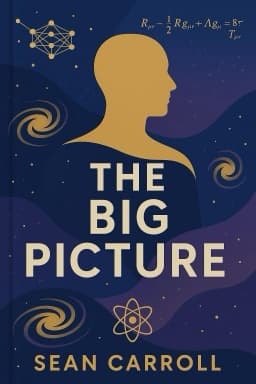
What if the universe is just atoms in motion, yet your love, memories, and sense of self are as real as the stars? Sean Carroll’s ‘The Big Picture’ offers a dazzling answer: reality is layered, and each layer has its own truths. At the deepest level, everything is atoms and quantum fields. But at the level of people, ships, and societies, new realities emerge—realities that matter to us.
Consider the Ship of Theseus: if you replace every plank, is it still the same ship? Carroll uses this ancient puzzle to show that identity is a useful fiction, not a fundamental property. The same applies to people—our bodies change, our atoms swap out, but our sense of self persists. These higher-level stories are not illusions; they are real in the context of their usefulness and coherence.
Carroll’s poetic naturalism allows us to embrace both science and poetry. Physics tells us what the world is made of, but poetry tells us what it means. Both are necessary for a full understanding of reality. Emergent properties—like consciousness, purpose, and value—arise naturally from the dance of atoms, yet cannot be found in any single particle.
The book dives into the mysteries of the mind, showing how billions of neurons create the experience of thought and awareness. No single neuron thinks or feels, but together, they give rise to the mind. This is emergence in action: simple rules, complex results.
‘The Big Picture’ encourages us to honor both the scientific and poetic sides of life. Our stories, dreams, and relationships are as real as atoms—because they are the patterns that matter most to us. In this way, Carroll’s vision is both humbling and empowering: we are stardust, but we are also storytellers.
Want to explore more insights from this book?
Read the full book summary