
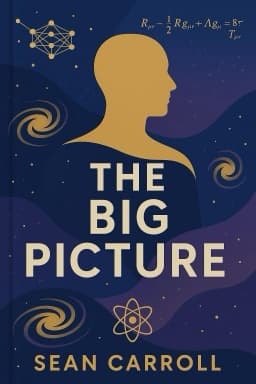
Unlocking the Cosmos: Why Sean Carroll’s ‘The Big Picture’ Will Change How You See Everything
A Journey Through Time, Space, and the Meaning of Life

A Journey Through Time, Space, and the Meaning of Life
Imagine standing beneath a night sky, the stars scattered in their billions, and realizing that your existence is both infinitesimal and precious. This is the feeling Sean Carroll evokes in ‘The Big Picture,’ a book that bridges the chasm between the cold equations of physics and the warm questions of human meaning. Carroll, a renowned theoretical physicist, doesn’t just explain the universe—he invites you to live more fully within it.
Carroll’s central idea is poetic naturalism: the notion that while there is one world, there are many valid ways to describe it. Physics gives us atoms and forces, but biology, psychology, and everyday language give us cells, minds, and stories. Each is real in its own context. This liberating perspective allows us to embrace both the rigor of science and the richness of human experience.
He takes us on a journey from the Big Bang—when the universe was a hot, uniform sea of particles—to the present, where complexity and consciousness have emerged. Along the way, Carroll dispels the myth that science robs life of meaning. Instead, he shows how the laws of physics, far from making us insignificant, set the stage for the emergence of life, mind, and purpose.
One of the book’s most powerful sections explores the nature of causality and determinism. Carroll explains that the universe moves not by purpose, but by patterns—laws that don’t care about our hopes or fears. Yet, within these patterns, complexity arises: flocks of birds, human societies, and, most wondrously, consciousness. He reassures us that while free will may be an emergent phenomenon, it is no less real or valuable for being so.
Carroll also tackles the age-old question: Why is there something rather than nothing? His answer is both honest and humbling. Some facts, he argues, may simply be brute—features of reality that have no deeper cause. This humility before the unknown is a recurring theme, encouraging readers to cherish curiosity while accepting that some mysteries may remain unsolved.
Throughout, Carroll’s writing is clear, lyrical, and often poetic. He draws on examples from daily life, thought experiments, and the latest scientific discoveries. The book is peppered with references to philosophy, history, and even pop culture, making it accessible and engaging for readers from all backgrounds.
‘The Big Picture’ is ultimately a call to courage and creativity. Carroll urges us to take responsibility for crafting meaning in a universe that offers none by default. Our values, purpose, and sense of wonder are not handed down from the stars—they are built, day by day, in the stories we tell and the lives we lead.
If you’ve ever wondered how science and meaning can coexist, or how to find purpose in a world ruled by impersonal laws, this book is for you. It’s a guide not just to understanding the cosmos, but to living well within it.
Ready to see the universe—and yourself—with new eyes?
Want to explore more insights from this book?
Read the full book summary