
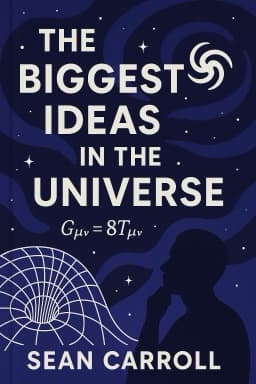
From Conservation to Black Holes: A Journey Through the Universe’s Biggest Ideas
Understanding the Cosmos One Idea at a Time

Sean Carroll’s The Biggest Ideas in the Universe offers a panoramic view of physics’ grandest concepts. The book begins with conservation laws—energy, momentum, and mass-energy equivalence—that provide the bedrock for understanding physical processes. Carroll explains how these laws emerge from symmetries in nature, a revelation credited to Emmy Noether.
Calculus is introduced as the indispensable tool to describe continuous change. Derivatives allow us to capture instantaneous rates, while integrals accumulate these changes, enabling precise predictions of motion. Carroll’s approach clarifies these mathematical ideas, linking them seamlessly to physical phenomena.
The book then explores dynamics, revealing the universal nature of harmonic oscillators and the principle of least action. These ideas show how local forces and global principles coexist to govern motion, from pendulums to planetary orbits.
Space and time are examined not as separate entities but as a unified spacetime fabric. Carroll discusses the philosophical and physical implications of this union, including the relativity of simultaneity and the arrow of time shaped by entropy.
Gravity emerges not as a force but as the curvature of spacetime, described elegantly by Einstein’s field equations. This geometric perspective explains phenomena like gravitational lensing and time dilation, reshaping our understanding of the cosmos.
The journey culminates with black holes—regions where spacetime curvature becomes extreme. Carroll explains event horizons, singularities, and Hawking radiation, highlighting these objects as frontiers of physics.
This book is a treasure trove for anyone eager to grasp the universe’s fundamental workings. For more insights, see Shortform’s detailed summary and Johns Hopkins Magazine’s interview with Sean Carroll. 4 1
Want to explore more insights from this book?
Read the full book summary