
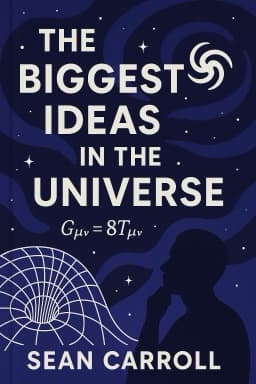
The Physics of Everything: How Sean Carroll’s Book Makes the Universe Understandable
Bringing Complex Physics to Life for Everyone

Physics can be intimidating, but Sean Carroll’s The Biggest Ideas in the Universe changes that narrative. With a unique blend of storytelling, philosophical reflection, and rigorous explanation, Carroll invites readers into the world of physics with warmth and clarity.
The book begins by grounding readers in conservation laws—fundamental truths that govern energy, momentum, and mass-energy. Carroll’s historical anecdotes enrich the scientific content, showing how ideas evolved and why they matter.
Calculus, often seen as a barrier, is presented as a natural language of change. Carroll’s analogies and examples make derivatives and integrals intuitive, linking math directly to physical experiences like motion and acceleration.
Space and time’s nature is explored with philosophical depth, discussing how relativity alters our perceptions and the profound implications for causality and the arrow of time. Carroll’s explanations of spacetime geometry and general relativity are both accessible and profound.
The final chapters on gravity and black holes reveal some of physics’ most exciting frontiers. Carroll’s clear descriptions of event horizons, singularities, and Hawking radiation illuminate these complex topics, making them understandable and fascinating.
This book is an essential resource for educators, students, and curious minds eager to grasp physics’ big ideas. For further perspectives, the Big Think review and Kirkus Reviews provide valuable critiques and praise. 2 3
Want to explore more insights from this book?
Read the full book summary