
Unlocking the Universe: The Biggest Ideas That Will Blow Your Mind!
Dive Deep into the Fundamental Laws Shaping Reality

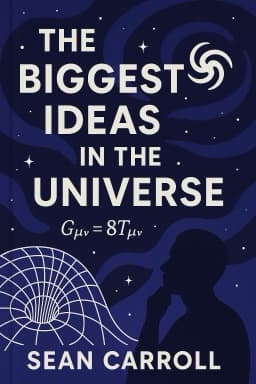
Imagine a universe where everything from the tiniest particle to the largest galaxy dances to a set of fundamental principles so elegant, they reveal the very nature of reality. Sean Carroll’s book, The Biggest Ideas in the Universe, invites us on an extraordinary journey to explore these principles. The book is not just a collection of facts but a philosophical and mathematical exploration that connects the dots between conservation laws, calculus, dynamics, the nature of space and time, and the enigmatic phenomena of black holes.
At the heart of physics lie conservation laws—energy, momentum, and mass-energy equivalence. Carroll explains how these laws are the universe’s commitment to constancy amidst change. The idea that momentum remains constant in an isolated system might seem abstract, but it explains everything from billiard ball collisions to why planets orbit the sun. The profound connection between symmetry and conservation, unveiled by Emmy Noether, shows that these laws are not arbitrary but rooted in the universe’s inherent symmetries.
Transitioning from constancy to change, calculus emerges as the indispensable language of nature’s flow. Derivatives capture instantaneous rates of change—how fast a car moves at any moment—while integrals accumulate these changes, giving us the total distance traveled. This mathematical framework resolves ancient paradoxes about motion and continuity, providing the tools to predict trajectories and dynamics precisely.
Carroll then brings us to the dance of dynamics, where forces cause motion and oscillations reveal nature’s rhythms. The simple harmonic oscillator model captures a surprising universality—near equilibrium, systems behave predictably with sinusoidal motion, from pendulums to atoms. The principle of least action offers a global perspective, showing that nature chooses paths minimizing a quantity called action, uniting local differential laws with a deep mathematical elegance.
But what about the stage itself? Space is not merely a passive container but a dynamic entity with geometry and dimensions shaping physical laws. Our three-dimensional space is essential for the stability of orbits and the existence of life. Non-Euclidean geometries describe how space can curve, a concept vital for understanding gravity.
Time, inseparable from space, forms the four-dimensional fabric of spacetime. The arrow of time, shaped by increasing entropy, gives direction to our experience. Special relativity reveals time’s relativity to observers and reshapes our notions of simultaneity and causality. Together, space and time form an arena where gravity is no longer a force but geometry itself, curving under the influence of mass and energy.
Einstein’s field equations mathematically bind mass-energy to spacetime curvature, predicting phenomena like gravitational time dilation—clocks running slower near massive bodies—and the bending of light. This geometric view transforms our understanding of gravity and the cosmos.
Finally, Carroll delves into black holes, cosmic enigmas where gravity’s pull is so intense that not even light escapes. The event horizon marks the boundary of no return, while the singularity at the center challenges classical physics, demanding a quantum theory of gravity. Hawking radiation, a quantum effect, reveals black holes slowly evaporate, connecting quantum mechanics, thermodynamics, and gravity in a profound synthesis.
Sean Carroll’s book is a testament to human curiosity and intellect, weaving together the biggest ideas in physics into a coherent, inspiring tapestry. It invites us all to engage with the universe’s mysteries, showing that these grand concepts are accessible and enriching for anyone willing to explore.
For more insights and detailed reviews, check out Johns Hopkins Magazine’s interview with Sean Carroll, Big Think’s review highlighting the book’s approach, and Shortform’s comprehensive summary to deepen your understanding. 1 2 4
Want to explore more insights from this book?
Read the full book summary