
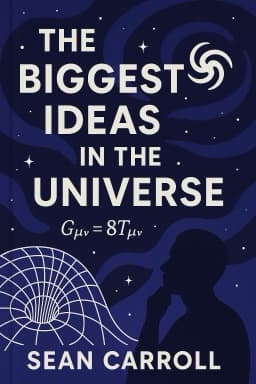
Why Sean Carroll’s 'The Biggest Ideas in the Universe' Will Change How You See Reality
A Mind-Bending Exploration of Space, Time, and Motion

Physics often feels like an exclusive club with complex jargon and intimidating mathematics. Sean Carroll breaks down these barriers in his book The Biggest Ideas in the Universe, making profound concepts approachable without sacrificing depth. This book is a gateway to understanding the universe’s fundamental laws, from the conservation principles that govern motion to the geometry of spacetime that shapes gravity.
One of Carroll’s key strengths is tracing the historical evolution of ideas. The concept of momentum, for instance, emerged from medieval notions of impetus, evolving into a precise physical quantity conserved in isolated systems. Emmy Noether’s theorem elegantly connects symmetries in nature to conservation laws, showing that these principles are not just empirical rules but deep mathematical truths.
Calculus, developed independently by Newton and Leibniz, is presented as the language of change, enabling us to measure instantaneous velocities and accumulate distances traveled. Carroll’s explanations demystify derivatives and integrals, revealing their central role in describing motion and dynamics.
Delving into dynamics, Carroll reveals the universality of oscillators and the principle of least action, a global view that nature’s paths minimize a quantity called action. This perspective enriches classical Newtonian mechanics and opens doors to modern physics.
Space and time are explored beyond everyday intuition. Carroll discusses the philosophical debate between substantivalism and relationalism, the importance of three spatial dimensions, and the revolutionary insight of spacetime from special relativity. The relativity of simultaneity and gravitational time dilation challenge our common-sense notions, showing the universe’s subtle complexity.
The culmination is a fascinating look at gravity as geometry and black holes as cosmic laboratories pushing physics to its limits. The event horizon’s causal boundary and the singularity’s mysteries invite readers to contemplate the universe’s deepest questions.
Carroll’s book is both an educational resource and a philosophical meditation, encouraging readers to appreciate the beauty and power of physics. For further reading, see Kirkus Reviews for a detailed critique and Big Think’s review emphasizing the book’s accessibility and depth. 3 2
Want to explore more insights from this book?
Read the full book summary