
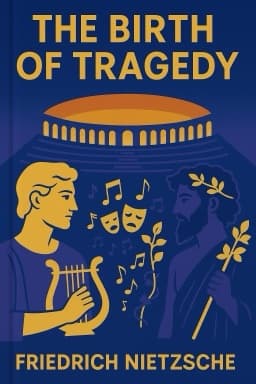
Unlocking the Secret Dance of Apollo and Dionysus: How Greek Tragedy Reveals Life’s Deepest Truths
Explore the profound duality that gave birth to Greek tragedy and why it still resonates today

At the heart of human culture lies a profound mystery: the tension between order and chaos, dream and ecstasy, individuation and unity. Friedrich Nietzsche’s The Birth of Tragedy masterfully unveils this mystery through the lens of ancient Greek tragedy, revealing a duality embodied by two gods — Apollo and Dionysus. This duality is not just mythological but metaphysical, shaping the very fabric of art and existence.
The Apolline force represents clarity, form, and beautiful illusion — the world of dreams where boundaries and individuation reign. Apollo’s light casts serene shadows that sculpt reality into comprehensible shapes. In contrast, the Dionysiac force embodies primal ecstasy, intoxication, and the dissolution of the self into a collective unity. Dionysus’s wild revels break down the walls of individuality, revealing the underlying chaos and unity beneath appearances.
Nietzsche shows that Greek tragedy arises from the fusion of these forces — the dreamlike images and dialogues of Apollo intertwined with the ecstatic chorus of Dionysus. This fusion creates a powerful art form that confronts the paradoxes of life: suffering and joy, fate and freedom, illusion and truth. Tragedy becomes an aesthetic justification of existence, affirming life despite its inherent pain.
However, this delicate balance was disrupted by the rise of Socratic rationalism, which emphasized knowledge, reason, and moral optimism. The chorus lost its central role, and tragedy shifted towards psychological realism and didacticism, losing its Dionysiac core. This cultural shift led to the decline of true tragedy, reflecting a broader loss of metaphysical depth in modernity.
Yet, music remains a beacon of the primal will, expressing what words cannot. Nietzsche elevates music as the highest art form, the direct voice of the metaphysical will that underpins existence. Myth arises as a symbolic narrative that translates the ineffable emotions music evokes into meaningful stories, bridging the gap between the primal and the rational.
The rebirth of tragedy through German music, especially the works of Wagner and Beethoven, signals a hopeful resurgence of the Dionysiac spirit. Their compositions blend mythic symbolism and emotional depth, offering a path beyond the sterile optimism of reason.
Ultimately, Nietzsche invites us to embrace life’s tragic dance with laughter — a sacred, courageous affirmation that transforms suffering into joyous acceptance. The figure of Zarathustra dances atop the mountain of existence, teaching us to laugh and celebrate despite life’s terrors.
By reconnecting with this tragic vision, we find a deeper meaning and vitality in life, learning to see existence as an aesthetic phenomenon worthy of our highest devotion.
Only as an aesthetic phenomenon is existence and the world justified.
Discovering this dance between Apollo and Dionysus enriches our understanding of art, culture, and the human condition — a journey that continues to inspire and challenge us today.
Sources: SparkNotes, Philosophy Now, Study.com 1 3 4
Want to explore more insights from this book?
Read the full book summary