
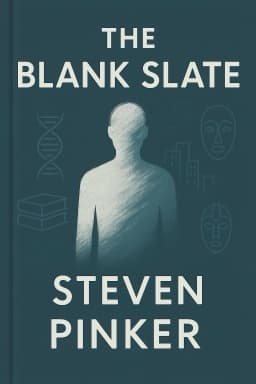
Why ‘The Blank Slate’ Will Change How You See Yourself Forever
Discover how Steven Pinker’s controversial masterpiece shatters the myth of the blank slate—and what it means for you.

Imagine waking up tomorrow and realizing that everything you believed about human nature—about your mind, your choices, your children, even your darkest impulses—was based on a comforting myth. This is the jolt Steven Pinker delivers in 'The Blank Slate: The Modern Denial of Human Nature,' a book that has sparked fierce debates, won awards, and, most importantly, changed the way millions think about what it means to be human.
Pinker’s central claim is simple yet radical: the idea that humans are born as blank slates—empty vessels waiting to be shaped by society—is not just wrong, but dangerously misleading. Drawing on decades of research, he shows that much of our behavior, from language to morality to aggression, is rooted in the architecture of our brains, shaped by evolution over millennia.
The book systematically dismantles three powerful myths: the blank slate (the mind as a blank page), the noble savage (the idea that humans are innately good and corrupted by society), and the ghost in the machine (the belief in a soul or mind separate from the body). Pinker’s argument is not that genes are destiny, but that genes and environment are partners in the dance of development. He brings to life studies of twins raised apart, the universality of emotions, and the cross-cultural patterns of language acquisition, weaving a compelling narrative that is both accessible and profound.
But 'The Blank Slate' is not just about science. It’s about the fears and hopes that surround the study of human nature: fears that acknowledging differences will justify discrimination, or that science will rob life of meaning. Pinker argues that the opposite is true. Recognizing our shared nature can deepen empathy, support equality, and help us design fairer, more realistic policies. He takes on the most charged issues—gender, violence, parenting, art, politics—and shows how a clear-eyed understanding of human nature can lead to a wiser, kinder world.
The book’s impact has been enormous, influencing debates in psychology, education, law, and beyond. Critics have challenged Pinker’s interpretations and warned of the dangers of biological determinism, but even his harshest opponents concede that the questions he raises are too important to ignore.
So, why will 'The Blank Slate' change how you see yourself? Because it forces you to confront the deepest questions: What am I? What can I change? What must I accept? And how can understanding the truth about human nature help us build a better future? Whether you agree with Pinker or not, you’ll never look at yourself—or your fellow humans—the same way again.
Sources: 1 2 3
Want to explore more insights from this book?
Read the full book summary