
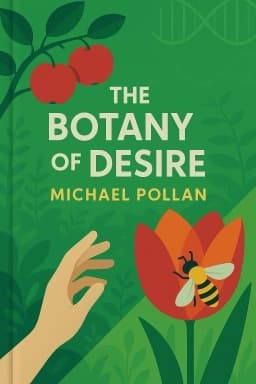
How Apples Manipulated Us: The Sweet Secret of Human Desire
Discover how the humble apple shaped—and was shaped by—our deepest cravings.

Discover how the humble apple shaped—and was shaped by—our deepest cravings.
Imagine biting into a crisp, juicy apple. The sweetness explodes on your tongue, a sensation both primal and comforting. But what if this pleasure was never about you at all? Michael Pollan’s 'The Botany of Desire' invites us to see the world through the apple’s eyes—or, more precisely, through the lens of mutual manipulation between plant and person. The apple’s journey, from the wild forests of Kazakhstan to orchards around the globe, is not merely a story of domestication but a tale of co-evolution, where human desire for sweetness and the apple’s evolutionary drive for survival intersect in surprising ways.
The apple’s wild ancestors still thrive in Central Asia, where forests burst with genetic diversity—tiny, tart, or sweet apples, all mingling together. Unlike most fruits, each apple seed is a genetic lottery, producing a tree unlike any other. This diversity was the apple’s secret weapon, allowing it to adapt to new environments and resist disease. When humans arrived, craving sweetness in a world where sugar was rare, they became the apple’s unwitting allies. By selecting and planting the most delicious fruit, we amplified the apple’s sweetest traits, and in return, the apple became a staple in our diets, a symbol in our stories, and a global commodity.
The legend of Johnny Appleseed captures this relationship perfectly. Far from planting cloned trees, he scattered seeds, fostering wild diversity and resilience. Most of these apples were too sour to eat, but perfect for making cider—a vital drink for early settlers. Through this partnership, the apple embedded itself in the fabric of American life, from frontier survival to modern supermarkets.
Yet, as our desire for uniformity grew, we began to favor a handful of perfect, sweet, red apples. Grafting replaced seeding, and the wild diversity that once protected the apple faded. Today, the risks of monoculture—disease, pests, climate change—remind us of the wisdom in nature’s original plan: resilience through variety. The apple’s story is a lesson in humility and interconnectedness, a reminder that we are not masters of nature, but participants in a shared evolutionary drama.
So next time you enjoy an apple, remember: you are part of an ancient dance, a story of sweetness, survival, and the subtle agency of plants. The apple has shaped us as much as we have shaped it, and its journey continues wherever seeds are sown and desires are kindled.
Want to explore more insights from this book?
Read the full book summary