
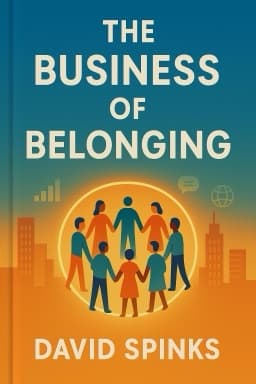
Why 'The Business of Belonging' is Your Ultimate Guide to Building Unstoppable Communities
Unlock the secrets to transforming your business with the power of authentic community.

In today's hyper-connected world, the concept of community has evolved from mere social interaction to a powerful business asset that can define the success or failure of a company. David Spinks' book, The Business of Belonging, offers a profound insight into this transformation, outlining how companies can harness the power of community to drive sustainable growth and lasting customer loyalty.
The journey begins by understanding that community is not just a group of people with shared interests—it is a dynamic ecosystem built on shared values, identity, and mutual influence. Spinks introduces the SPACES model, which categorizes community impact into six measurable business outcomes: Support, Product, Acquisition, Contribution, Engagement, and Success. Each of these areas offers a unique avenue through which community can move the needle on business goals, from reducing support costs to driving product innovation and customer acquisition.
One of the most compelling aspects of the book is its focus on social identity—the emotional heartbeat of any community. Spinks draws on psychological theories to explain how a sense of belonging, influence, and shared emotional connection motivates members to participate actively and take ownership. This is further explored through the Commitment Curve, a model illustrating how members progress from passive lurkers to active contributors and eventually leaders, emphasizing the importance of intentional onboarding and community design.
Spinks also delves into the art of motivating community members, balancing intrinsic motivations like personal fulfillment and belonging with extrinsic rewards such as status and perks, guided by the SNAP! framework. This nuanced approach ensures that communities foster authentic engagement rather than transactional participation.
Designing community spaces—both physical and virtual—is another critical pillar. The 7Ps framework (People, Purpose, Place, Participation, Policy, Promotion, Performance) guides leaders to create environments that are welcoming, purposeful, and conducive to meaningful interaction. Small-group discussions, peak moments, and rituals are highlighted as tools to deepen emotional bonds and retention.
Activating engagement is described as a continuous experiment, where personalized outreach, transparency, and positive moderation cultivate a thriving culture. Spinks stresses that moderation is a form of service, not enforcement, and that authentic communication builds trust and energy.
Perhaps most importantly, the book addresses the delicate balance between business imperatives and human connection. Sustainable communities require both financial viability and genuine care for members. Founders play a crucial role in maintaining this balance, ensuring that as organizations scale, the community’s soul remains vibrant.
Finally, Spinks positions community as a competitive moat—an irreplaceable asset that creates emotional switching costs and social capital, making it difficult for competitors to replicate. However, he cautions that building this moat requires patience, often taking 6-12 months or more to realize measurable impact.
In essence, The Business of Belonging is a call to action for businesses to rethink how they engage with customers and employees by placing belonging at the center of their strategy. It is a comprehensive, actionable guide that blends theory with practice, psychology with business, and passion with professionalism. For anyone interested in building communities that endure and empower, this book is an indispensable resource.
Whether you manage a small online forum or lead a global brand, the insights within this book can transform your approach, making community not just a part of your business but your greatest competitive advantage.
Get ready to dive deep into the art and science of belonging, and unlock the full potential of your community.
Sources: Blinkist summary 1 , Nityesh book review 2 , 5minutebooksummary.com 3
Want to explore more insights from this book?
Read the full book summary