
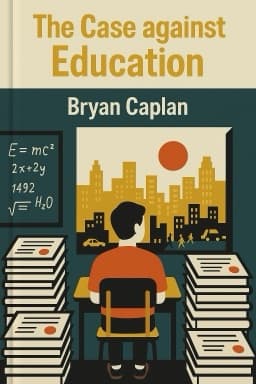
The Great Education Hoax: Why Learning Fades and Credentials Remain
Do you remember your high school algebra? Here’s why you probably don’t—and why it doesn’t matter.

Picture yourself at a high school reunion. How much of what you learned in those years can you actually recall? If you’re like most people, the answer is: not much. This is not a quirk of memory, but a predictable result of how our brains work. Bryan Caplan’s 'The Case Against Education' marshals evidence from dozens of studies to show that most of what we learn in school is forgotten within years. The infamous 'forgetting curve'—first described by psychologist Hermann Ebbinghaus—shows that knowledge decays rapidly unless it’s used regularly. Adults who once aced algebra or Spanish typically remember almost nothing decades later.
But here’s the kicker: this mass forgetting doesn’t seem to matter in the job market. Employers rarely test your knowledge; they look for your degree. Why? Because education is a signal, not a storehouse of skills. Caplan’s research reveals that the real value of education lies in showing you can jump through hoops, not in what you actually know. The few skills that do stick—like basic literacy and numeracy—are learned early and used often. Everything else fades.
This has profound implications. If school doesn’t teach useful skills, why do we spend so much time and money on it? Caplan argues that we should shift resources toward practical, hands-on training and recognize that most learning happens on the job. For students, this means focusing less on grades and more on building real-world experience. For policymakers, it means questioning the value of ever-expanding subsidies for higher education. The great education hoax isn’t that students are lazy or teachers are bad—it’s that the system is built on the illusion of learning, when what really matters is the credential you carry.
References: 2 , 4
Want to explore more insights from this book?
Read the full book summary