
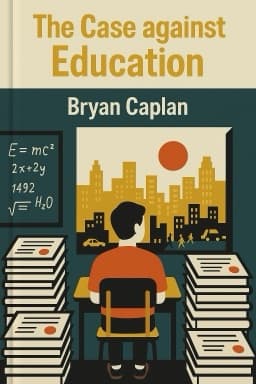
Why Most of School is a Waste: The Startling Truth Behind Education’s Real Purpose
Is your diploma just a golden ticket? Discover why school is less about learning and more about signaling.

Imagine spending thousands of hours in classrooms, memorizing facts, formulas, and literary devices—only to realize, years later, that almost none of it remains in your mind or is used in your daily work. This isn’t just a personal failing; it’s a systemic reality. In his controversial book, 'The Case Against Education,' Bryan Caplan lays bare a truth that many suspect but few dare to say aloud: school is less about learning and more about signaling. The vast majority of what we learn in school is quickly forgotten, and employers care far more about your degree than the actual content of your education.
Caplan’s argument is built on the concept of signaling theory. Employers use educational credentials as a shortcut to judge who is intelligent, diligent, and conformist enough to succeed in the workplace. The notorious 'sheepskin effect'—where completing a degree yields a much larger salary boost than simply attending for a few years—proves that it’s the credential, not the knowledge, that matters most. Studies show that adults forget nearly everything they learned in high school except for basic literacy and numeracy. Even advanced math, history, and foreign languages fade rapidly unless used daily.
This system leads to credential inflation: as more people earn degrees, employers raise their requirements, turning college into the new high school. Jobs that once needed a diploma now demand a bachelor’s, and the real-world skills required haven’t changed. Billions are spent on education, but the social return is minimal—most of the benefit accrues to individuals who outcompete their peers, not to society as a whole. Caplan’s critique is supported by international comparisons, showing that countries with robust vocational training systems, like Switzerland and Germany, achieve lower youth unemployment and higher job satisfaction than the U.S., where college is seen as the only path.
So what’s the solution? Caplan suggests we rethink subsidies for higher education, encourage alternatives like vocational training, and recognize that real expertise is built on the job, not in the classroom. Whether you agree or disagree, this book will challenge your assumptions about what school is really for—and why it may be time for a radical rethink. Is your diploma just a golden ticket, or is it proof of something more? The answer may surprise you.
References: 1 , 2 , 3
Want to explore more insights from this book?
Read the full book summary