
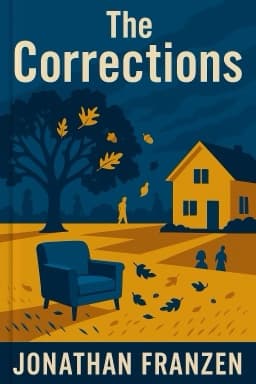
Why 'The Corrections' Still Defines the Modern American Family
Unpacking the Enduring Power of Franzen's Masterpiece

Unpacking the Enduring Power of Franzen's Masterpiece
Few novels have captured the essence of the American family quite like Jonathan Franzen’s The Corrections. Set at the dawn of the 21st century, the story orbits the Lambert family—Alfred and Enid, and their three adult children, Gary, Chip, and Denise—each struggling with their own disappointments and the weight of unmet expectations. Franzen’s prose is both cutting and compassionate, laying bare the quiet tragedies and absurdities of everyday life. The novel is a mirror reflecting the anxieties of a generation grappling with change, consumerism, and the elusive promise of happiness.
The Lamberts’ story is not unique, and that is precisely its power. Alfred’s decline into Parkinson’s and dementia, Enid’s relentless optimism, Gary’s desperate grasp for control, Chip’s creative and professional chaos, and Denise’s search for belonging—these are struggles many readers recognize. Franzen weaves these threads into a tapestry that is as hilarious as it is heartbreaking. He shows us how family gatherings can be battlegrounds for old resentments, but also places where forgiveness and understanding are possible. The book’s title itself is a nod to the corrections we try to make—to ourselves, to our loved ones, and to the past.
Franzen’s exploration of consumer culture is especially prescient. The Lamberts, like so many families, attempt to fill emotional gaps with material comforts, only to find that fulfillment remains out of reach. The novel’s social commentary is sharp, yet never loses sight of the humanity at its core. The Corrections is, ultimately, a novel about hope—the hope that, even in the face of disappointment and change, families can find their way back to one another.
Twenty years after its publication, The Corrections remains a must-read for anyone interested in the complexities of family life and the changing face of America. Its resonance endures because it tells the truth: families are messy, but they are also where we find our greatest chances for redemption.
Sources: Medium Book Review, The Guardian Book Club, Goodreads Reader Comments 1 2 4
Want to explore more insights from this book?
Read the full book summary