
Unlock Your Brain’s Hidden Power: The Surprising Secrets Behind Creative Thinking
How understanding your own mind can revolutionize your creativity and decision-making

Have you ever wondered why some people seem to effortlessly generate brilliant ideas while others struggle to think beyond the obvious? The secret often lies not in raw intelligence but in the ability to understand and manage one's own thinking process—a skill known as metacognition.
Our brains rely heavily on routine mental patterns to conserve energy. While this autopilot mode helps us navigate daily life efficiently, it can also trap us in repetitive loops that stifle innovation. Imagine trying to solve a puzzle but only using the same few pieces repeatedly. This is the challenge that metacognition helps us overcome by shining a light on our thought habits and enabling strategic shifts.
One common mental trap is confirmation bias—the tendency to seek out information that confirms our existing beliefs while ignoring contradictory evidence. This selective thinking narrows our perspective and limits the range of ideas we consider. For example, in business, companies that cling to their first successful product without questioning underlying assumptions often lose ground to more adaptable competitors.
Our thinking operates in two modes: a fast, reactive system that handles everyday decisions quickly, and a slower, reflective system that enables deep analysis. While the fast system is essential for survival, over-reliance on it can lead to hasty judgments and missed creative opportunities. Balancing these systems allows for thoughtful innovation.
Breaking free from assumptions is another vital step toward creative breakthroughs. Assumptions act like invisible filters shaping how we interpret problems and solutions. By questioning these beliefs, whether cultural norms or outdated rules, we open doors to fresh perspectives and novel ideas.
To harness creativity systematically, a proven four-step process can guide us: Understanding the challenge, generating ideas (ideation), analyzing options, and setting direction for implementation. This framework balances divergent thinking—expanding possibilities—with convergent thinking—narrowing down to the best solutions.
Creativity thrives with commitment. Like any skill, it requires regular practice, dedicated time, and an open mindset that embraces curiosity and resilience. Leaders who foster psychological safety and encourage experimentation create environments where innovation flourishes, empowering teams to take bold steps without fear of failure.
Ultimately, creativity is a lifelong journey. Sustaining it means integrating creative habits into daily life, welcoming challenges, and persisting through setbacks. By nurturing this mindset, anyone can unlock their brain’s hidden power and transform ideas into impactful realities.
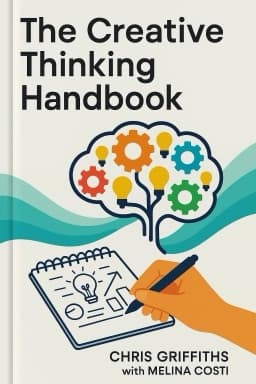
This exploration is based on insights from the book The Creative Thinking Handbook and supplemented by research on cognitive science and innovation practices from leading sources in psychology and business creativity. 1 2 3
Want to explore more insights from this book?
Read the full book summary