
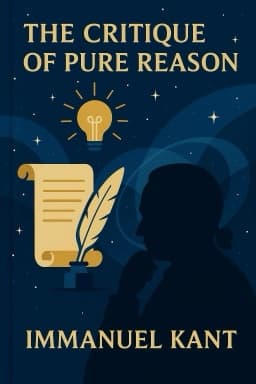
Unlocking the Mind: How Kant’s Critical Philosophy Changed Everything You Thought About Knowledge
Discover the revolutionary ideas that reshaped modern thought and why understanding Kant is essential for anyone curious about how we know what we know.

Introduction: A New Dawn in Philosophy
In the landscape of human thought, few figures loom as large as Immanuel Kant, whose critical philosophy marks a turning point in our understanding of knowledge. Prior to Kant, philosophical traditions were divided between rationalists, who believed knowledge comes primarily from reason, and empiricists, who argued all knowledge derives from experience. Kant’s genius was to synthesize these views, showing that while knowledge begins with experience,
The Foundation: A Priori and A Posteriori Knowledge
Kant introduced the crucial distinction between a priori knowledge—knowledge independent of experience—and a posteriori knowledge, which depends on sensory data. Mathematical truths like '7 + 5 = 12' exemplify a priori knowledge: they are necessarily true and universal, known through reason alone. In contrast, empirical facts such as 'water boils at 100°C' rely on observation and can vary with conditions.
This distinction revolutionized epistemology by showing that the mind contains innate frameworks that make experience intelligible. These pure intuitions of space and time are not learned but conditions for perceiving the world.
Space and Time: The Mind’s Lenses
Kant argued that space and time are not external realities but
This insight transformed natural science and philosophy by revealing the subjective conditions underlying objective knowledge.
The Mind’s Toolbox: Categories of Understanding
Beyond intuitions, the mind uses
The Limits and Powers of Reason
Reason naturally seeks the unconditioned—the ultimate causes and totalities—but this pursuit can lead to contradictions known as antinomies. Kant’s critical philosophy disciplines reason by setting limits to speculative metaphysics, preventing dogmatism and skepticism. Instead, reason finds its highest use in practical domains such as morality and freedom.
Moral Freedom and Practical Reason
While theoretical reason is bounded, practical reason transcends these limits by grounding moral law and freedom. Kant showed that freedom is a necessary postulate for moral responsibility, even if it cannot be empirically proven. This practical use of reason affirms human dignity and autonomy.
The Self and the Unity of Experience
Central to Kant’s philosophy is the synthetic unity of apperception—the mind’s ability to unify diverse experiences under the
Phenomena and Noumena: Knowing and Mystery
Kant distinguished between phenomena (the world as we experience it) and noumena (things in themselves), which remain unknowable. This distinction protects us from overreaching claims and fosters epistemic humility.
The Enduring Legacy
Kant’s critical philosophy laid the groundwork for modern epistemology, ethics, and metaphysics. It remains a vital guide for navigating the complexities of knowledge, reason, and morality. By embracing the limits and powers of our faculties, we gain a balanced, hopeful approach to understanding ourselves and the world.
Conclusion: Dare to Know
In the spirit of enlightenment, Kant invites us to 'Dare to know!'—to courageously use our reason, question assumptions, and pursue wisdom with humility and rigor. This journey through critical philosophy opens the door to a deeper, more reflective life, where knowledge and freedom walk hand in hand.
Want to explore more insights from this book?
Read the full book summary