
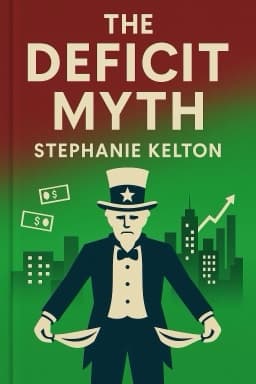
Debunking the National Debt Nightmare: What The Deficit Myth Reveals About Our Financial Future
Why the national debt is not the catastrophe many believe it to be.

National debt numbers can be intimidating, often portrayed as a ticking time bomb threatening economic collapse. But Stephanie Kelton’s The Deficit Myth reveals that the national debt is not a burden but a record of wealth held by the private sector.
Government debt consists of Treasury bonds—interest-bearing dollars that households, businesses, and institutions hold as safe assets. When the government runs deficits, it adds these assets to the economy, increasing private savings and supporting economic stability.
Historical evidence shows that even with high debt-to-GDP ratios, such as post-World War II America, the economy can thrive, with rising incomes and broad prosperity.
Paying off the national debt entirely is not necessarily desirable. Doing so would remove these financial assets from circulation, potentially triggering recessions and slowing growth. Unlike households, the US government issues debt in its own currency and cannot involuntarily default on its obligations.
Understanding the national debt in this way frees us from the paralyzing fear that drives austerity and undermines vital public investments.
For more detailed discussions, see sources from Hustle Escape, Foreign Affairs, and SuperSummary [[1]](#__1) [[3]](#__3) [[0]](#__0).
Want to explore more insights from this book?
Read the full book summary