
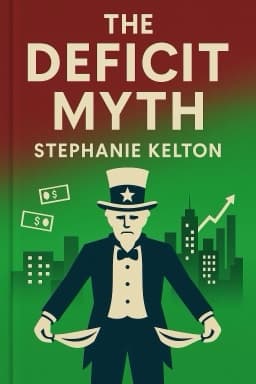
The Deficit Myth: How Inflation—not Debt—Is the Real Enemy of Our Economy
Understanding why inflation, not deficits, should guide government fiscal policy.

When it comes to government spending, the dominant narrative warns of ballooning deficits leading to runaway inflation. But Stephanie Kelton’s The Deficit Myth challenges this view, showing that inflation—not deficits—is the true limit on government spending.
Inflation occurs when spending outpaces the economy’s capacity to produce goods and services, creating demand-pull pressure on prices. This is a real resource constraint, not simply a monetary phenomenon. Deficits themselves can be too small, causing unemployment and economic weakness if government spending fails to stimulate sufficient demand.
Kelton critiques the Federal Reserve’s reliance on the 'natural rate of unemployment' (NAIRU), a theoretical and unobservable concept that often leads to premature interest rate hikes and unnecessary job losses. Instead, she proposes a federal job guarantee as a policy that can stabilize employment and inflation by providing jobs at a fixed wage, anchoring wages and prices.
This approach reframes deficits as tools to maintain economic health rather than problems to be feared. By focusing on inflation as the true constraint, policymakers can support full employment and equitable growth without risking price instability.
Understanding this distinction helps dispel common fears and opens the door to more effective fiscal policies that prioritize real economic outcomes over arbitrary budget targets.
For further reading, consult analyses from Foreign Affairs, the London School of Economics, and SuperSummary [[3]](#__3) [[2]](#__2) [[0]](#__0).
Want to explore more insights from this book?
Read the full book summary