
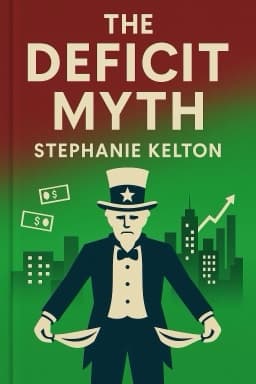
Why Everything You Know About Government Debt Is Wrong: The Deficit Myth Exposed!
Unveiling the truths behind government deficits and national debt with Stephanie Kelton’s groundbreaking insights.

For decades, conventional wisdom has told us that government budgets are like household budgets: if you spend more than you earn, you go broke. Stephanie Kelton’s The Deficit Myth shatters this illusion by introducing us to Modern Monetary Theory (MMT), which reveals that sovereign currency issuers like the United States operate under fundamentally different rules.
At the heart of Kelton’s argument is that the federal government issues its own currency and therefore cannot run out of money in the way households can. Taxes do not fund spending; instead, government spending creates the money that taxes then remove from circulation to create demand for the currency. Borrowing is simply the issuance of interest-bearing currency, not a loan from the public to the government.
This means that deficits—the gap between government spending and tax revenue—are not inherently bad. In fact, deficits add net financial assets to the private sector, increasing savings and supporting economic growth. The true limit to government spending is inflation, which arises when spending pushes beyond the economy’s capacity to produce real goods and services.
Kelton also debunks the myth that the national debt is a burden on future generations. Instead, government debt represents private sector savings in the form of Treasury bonds. Paying down the debt entirely would remove these assets from the economy, potentially causing recessions and harming growth.
Foreign holdings of US debt do not imply dependence on other countries. These holdings are dollar assets accumulated through trade surpluses, and because the US controls its currency, it cannot be forced into default by foreign creditors.
Entitlement programs like Social Security and Medicare are sustainable because the government issues its own currency. Challenges from aging populations are about managing real resources, not money. Fiscal responsibility, Kelton argues, should be redefined to focus on managing inflation, employment, and equitable growth rather than balancing budgets.
Finally, embracing MMT opens new horizons for progressive policies, allowing governments to invest boldly in infrastructure, healthcare, education, and climate action without fear of arbitrary financial constraints.
In summary, 'The Deficit Myth' invites us to rethink our economic assumptions and empowers us to imagine an economy that works for everyone.
For more in-depth analysis, see sources from SuperSummary, Hustle Escape, and the London School of Economics [[0]](#__0) [[1]](#__1) [[2]](#__2).
Want to explore more insights from this book?
Read the full book summary