
10 Surprising Ways You Lie to Yourself Every Day (And Why It Matters More Than You Think!)
Unlocking the Secret Patterns of Self-Deception for a More Honest Life

Unlocking the Secret Patterns of Self-Deception for a More Honest Life
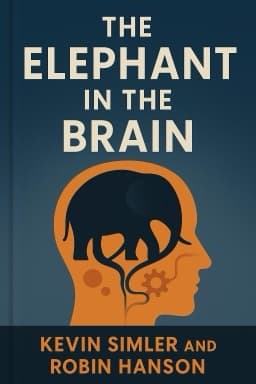
Imagine waking up every morning with a silent companion—one you never truly acknowledge, yet who shapes nearly every decision you make. This isn’t the plot of a psychological thriller but the premise of The Elephant in the Brain by Robin Hanson and Kevin Simler. The “elephant” is your hidden motives: the powerful, unspoken forces that nudge your actions, color your beliefs, and even influence the way you see yourself. Most of us think we’re honest, rational actors, but the truth is far stranger—and much more fascinating.
Why do we so often fail to see our own selfishness? The answer, according to Hanson and Simler, lies in evolution. Long before we built cities or wrote books, our ancestors survived not just by outwitting predators, but by outwitting each other. Social life is a game, and in this game, it pays to look good—even if you’re secretly playing for yourself. That’s why our brains evolved to hide our real motives, not only from others but from ourselves. Self-deception is an evolutionary strategy: if you can believe your own story, you can sell it to others more convincingly. This is why, as the authors show, we’re often blind to the real reasons behind our actions, from why we help others to why we seek education or medical care. 1
How Hidden Motives Shape Everyday Life
Let’s start with charity. Most people say they give because they want to help, but studies show that donations skyrocket when giving is public. Hospitals, universities, and even local parks proudly display donor names. Why? Because charity is as much about signaling generosity and earning status as it is about helping others. The same is true in healthcare. We like to believe we seek medical care for our health, but research reveals much of it is about reassurance and displaying care for loved ones—explaining why unnecessary treatments are so common.
Education is another arena where hidden motives run wild. While we claim school is about learning, the real value often lies in signaling intelligence, diligence, and conformity to potential employers. Diplomas act as badges, not just certificates of knowledge. Even in everyday conversation, we’re constantly signaling—showing off knowledge, humor, or compassion, often without realizing it. 2
The Social Brain: Why Lying to Ourselves Makes Sense
What’s the evolutionary logic behind all this self-deception? In a world where your reputation is everything, it pays to appear virtuous—even if you’re not. If you can truly believe your motives are pure, you’re less likely to slip up, get caught, or be accused. The brain, then, acts like a press secretary, spinning stories that make us look good. This isn’t just a metaphor: studies show we’re better at solving logic puzzles when framed as cheating scenarios, suggesting our brains have specialized modules for detecting (and hiding) norm violations. 3
But self-deception isn’t just about fooling others. Sometimes, not knowing is a strategic advantage. If you’re unaware of a damaging fact, you can’t be accused of hiding it. If you genuinely believe you’re acting for noble reasons, you’re more convincing—and more likely to win allies.
Institutions: Mirrors of Our Hidden Motives
Our schools, hospitals, and charities are not just tools for learning, healing, or helping—they’re platforms for signaling. Hanson and Simler argue that much of what we call “waste” in these institutions is actually the point. The elaborate rituals of education, the excesses of medical care, and the public displays of giving all serve to advertise our qualities to others. This is why reforms that ignore hidden motives often fail: they target the stated purpose, not the real one.
Even our rules and norms are shaped by hidden motives. Norms are enforced not just directly but through meta-norms—rules about enforcing rules. Gossip, far from being idle chatter, is a powerful tool for coordinating group responses to norm violations. The result is a complex dance, where everyone is watching, judging, and ready to act.
Cheating, Plausible Deniability, and the Art of Looking Good
Of course, not everyone plays by the rules. Cheating is a universal human behavior—but it’s rarely blatant. Most people cheat just enough to gain an advantage while maintaining plausible deniability. Think of jaywalking, drinking from a paper bag in public, or fudging a little on your taxes. As long as the cheating isn’t public knowledge, it’s often ignored. Our brains are wired to spot norm violations, but also to exploit ambiguity. 4
This arms race between cheaters and norm enforcers drives ever greater subtlety and creativity. The best cheaters are those who can keep their actions just ambiguous enough to avoid punishment, while norm enforcers develop new strategies to detect and deter them.
Can We Ever Truly Know Ourselves?
So, what’s the takeaway? Are we doomed to be blind to our own motives forever? Not at all. While true self-knowledge is rare and difficult—it requires humility and courage—it’s also the first step to wisdom. By recognizing our hidden motives, we become less likely to be ruled by them. We can build more honest relationships, make better choices, and forgive ourselves (and others) for being human. Compassion grows from insight; humility is the root of wisdom.
The elephant in the brain is not an enemy, but a companion on the journey to understanding. The more clearly we see it, the more power we have to change—for ourselves and for those around us.
Want to explore more insights from this book?
Read the full book summary