
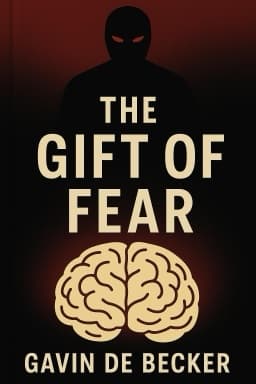
Unlocking the Secret Language of Danger: How ‘The Gift of Fear’ Can Save Your Life
Discover the hidden signals that your intuition sends you to protect yourself from violence and harm.

Imagine walking down a quiet street at dusk, your senses alert but your mind at ease. Suddenly, a subtle unease creeps in—a whisper from within that something is not quite right. This feeling, often dismissed as irrational fear, is actually your brain’s powerful survival tool: intuition.
In 'The Gift of Fear,' Gavin de Becker shatters the illusion that violence is random. Instead, he reveals that most violent acts are preceded by clear survival signals—subtle cues that predators use and victims often overlook. These include forced teaming, where a stranger creates a false sense of partnership, charm used as a weapon to disarm suspicion, and persistence that ignores boundaries and refusals.
For example, a woman carrying groceries might be approached by a stranger who says, 'We’ve got a hungry cat upstairs,' implying a shared purpose. While it seems harmless, this forced teaming is a manipulative tactic to lower defenses.
De Becker also dives into the psychology of violence, showing that violent individuals often share common traits shaped by childhood trauma, neglect, or abuse. Understanding this shared humanity helps break denial and improves prediction of violent behavior.
Prediction is further enhanced by models like JACA, which considers justification, alternatives, consequences, and ability to act, and RICE, which evaluates reliability, importance, cost, and effectiveness of precautions. These frameworks help transform fear from a vague feeling into a practical tool for safety.
Fear itself is a gift, not a curse. It triggers immediate protective responses essential for survival, but it must be distinguished from anxiety or misplaced fear that can limit freedom unnecessarily. Training oneself to listen and interpret fear accurately refines intuition and enhances safety.
Threats and persistence are two of the most critical warning signs. Threats are promises of harm and often precede violence, while persistence—refusing to accept rejection—signals escalating danger. Legal protections like restraining orders can help but are often insufficient alone, requiring early action and comprehensive safety planning.
Ultimately, the book empowers readers to embrace fear and trust their intuition, reclaiming control over their safety and lives. By recognizing the secret language of danger and acting on it, you can live with confidence and freedom.
Whether you are a parent, professional, or simply someone who wants to feel safer, 'The Gift of Fear' offers timeless wisdom and practical advice. It invites us all to listen to our inner guardian and honor the gift that fear truly is.
Stay tuned as we explore more insights and real-life applications of these life-saving concepts in the following blogs.
Want to explore more insights from this book?
Read the full book summary