
String Theory: The Boldest Idea in Physics or a Beautiful Mirage?
Why String Theory Inspires—and Divides—Scientists

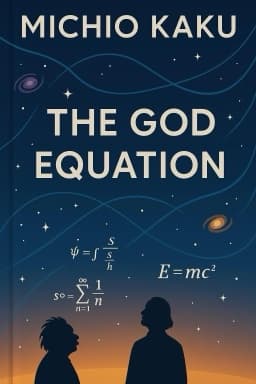
Imagine a universe where every particle, every force, and every law of nature is explained by the vibrations of tiny, invisible strings. That’s the promise of string theory—a vision so audacious that it has captivated generations of physicists and inspired countless books, including Michio Kaku’s 'The God Equation.' But after decades of research, string theory remains untested, and its critics are growing louder.
String theory’s appeal lies in its mathematical beauty. It weaves together quantum mechanics and general relativity, predicts the graviton (the quantum of gravity), and suggests that reality consists of up to eleven dimensions. It even opens the door to the multiverse—a landscape of possible universes, each with its own physical laws.
Yet, the theory’s very flexibility is also its greatest weakness. Because it allows for so many possible universes, critics argue it can explain almost anything—and therefore, nothing. Experimental evidence is lacking; the energies required to probe string scales are far beyond current technology. Some physicists worry that string theory is drifting from science into philosophy, promising answers but providing few testable predictions.
Kaku addresses these criticisms openly. He points out that string theory has already enriched mathematics and inspired new ways of thinking about space, time, and information. Even if the theory is never proven, it has changed the landscape of theoretical physics. Supporters believe that future advances—perhaps in cosmology, black hole physics, or quantum computing—may provide the evidence needed.
The debate over string theory is about more than equations. It’s about what science can and should be. Is beauty a guide to truth? Should theories be judged by their elegance or their testability? As the search for the God Equation continues, string theory stands as both a beacon of hope and a challenge to our understanding of reality.
Whether string theory is ultimately proven, disproven, or replaced, its legacy will endure. It has shown us that the universe may be stranger, richer, and more beautiful than we ever imagined—and that the greatest mysteries are still ahead.
Want to explore more insights from this book?
Read the full book summary