
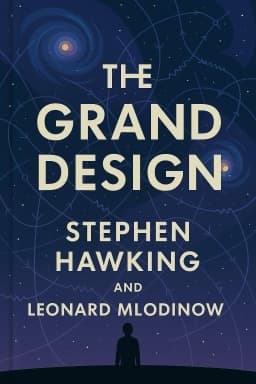
Quantum Mechanics and the Multiverse: How The Grand Design Rewrites Reality
Dive deep into the quantum world and multiverse concepts that underpin the universe’s mysterious origins.

At the heart of modern physics lies quantum mechanics, a theory so counterintuitive that even its pioneers admitted its mysteries. The Grand Design takes us on a journey through this strange landscape, where particles are not just points but waves, capable of traversing every possible path simultaneously. This concept, known as the sum-over-histories or path integral formulation, reveals that reality is not a single fixed narrative but a superposition of many possible histories.
Imagine an electron fired at a double slit. Instead of passing through one slit or the other, it behaves as if it passes through both, creating an interference pattern that defies classical explanation. This wave-particle duality is a cornerstone of quantum mechanics and challenges our everyday notions of reality.
Extending these ideas to the cosmos, The Grand Design proposes that the universe itself emerged from quantum fluctuations in a primordial quantum state. The no-boundary proposal suggests that the universe has no temporal boundary, avoiding the classical singularity and allowing the cosmos to arise naturally from the laws of physics.
Moreover, the multiverse theory emerges naturally from these quantum cosmological models. Our universe is just one bubble in a frothing sea of universes, each with different physical constants and laws. This vast landscape explains the fine-tuning problem: among countless universes, only a few have the right conditions for life, and we find ourselves in one of those.
These revolutionary concepts force us to reconsider causality, observation, and the nature of existence. Observers play a crucial role in collapsing quantum possibilities into a definite reality, blurring the lines between cause and effect. The Grand Design invites us to embrace a universe far stranger and more wondrous than classical physics ever imagined.
For those fascinated by the quantum realm and cosmology, this book offers a rich, accessible exploration of ideas that continue to shape cutting-edge research and philosophical debate.
Want to explore more insights from this book?
Read the full book summary