
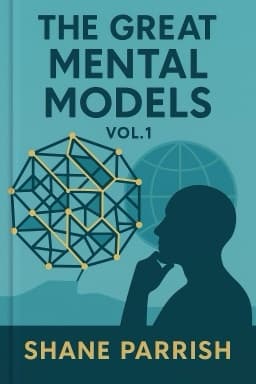
The Mental Models Toolbox: 8 Must-Know Frameworks to Master Any Challenge
Equip yourself with the eight essential mental models that top performers use to solve problems and innovate.

Imagine having a toolbox filled with versatile instruments that can tackle any problem, no matter how complex. Mental models are exactly that—intellectual tools that help us dissect challenges, see hidden patterns, and make smarter decisions.
Here are eight foundational mental models that form the core of effective thinking:
- The Map is Not the Territory: Recognize that your perceptions are simplified representations, not reality itself. This awareness guards against mistaking models for truth.
- Circle of Competence: Stay within your areas of expertise and know your limits to avoid costly mistakes.
- First Principles Thinking: Break problems down to their fundamental truths and build solutions from the ground up.
- Second-Order Thinking: Anticipate the ripple effects and consequences beyond the immediate outcomes.
- Probabilistic Thinking: Embrace uncertainty by estimating likelihoods and updating beliefs as new evidence emerges.
- Inversion: Think backwards by focusing on what to avoid or how to fail, to find creative solutions.
- Hanlon’s Razor: Assume error rather than malice in others’ actions to foster clearer judgment and reduce conflict.
- Latticework of Mental Models: Integrate diverse models from multiple disciplines into a connected framework for robust understanding.
For example, inversion thinking led to the invention of CCTV by reframing the problem of how to see outside one’s home without leaving it. Similarly, Hanlon’s Razor played a critical role during the Cuban Missile Crisis by encouraging assumption of error over hostility, helping prevent nuclear war.
Applying these models in daily life enhances problem-solving, creativity, and decision-making. Start by identifying your circle of competence and practicing first principles thinking on a current challenge. Use second-order thinking to foresee consequences before acting, and apply probabilistic thinking to weigh risks realistically.
By equipping yourself with this mental models toolbox, you prepare to face any intellectual challenge with confidence and clarity.
Sources: The Great Mental Models by Shane Parrish, Farnam Street blog, Goodreads, Acquirers Multiple.
Want to explore more insights from this book?
Read the full book summary