
Unlock Your Brain’s Hidden Power: How Mental Models Can Revolutionize Your Thinking
Discover the secret frameworks that top thinkers use to master complexity and make smarter decisions every day.

Every day, we are bombarded with information, faced with complex decisions, and challenged by problems that seem overwhelming. Yet some people navigate this complexity with remarkable ease, making decisions that seem almost effortless and insightful. What’s their secret? It’s the use of mental models—powerful cognitive frameworks that simplify complexity and guide thinking.
Mental models are not just abstract theories; they are practical tools that help us understand reality by distilling it into manageable concepts. The phrase 'the map is not the territory' reminds us that our perceptions and beliefs are simplified representations—not the full reality. Recognizing this distinction is the first step toward clearer thinking. For example, Newtonian physics served as an effective map for centuries but was eventually refined by Einstein’s relativity, showing how models evolve as knowledge deepens.
Understanding your 'circle of competence'—the boundaries of what you truly know—prevents costly errors born from overconfidence. Like a seasoned local guiding a newcomer through a complex town, staying within your expertise ensures wiser decisions. This humility opens the door to continuous learning and reflection.
One of the most powerful approaches to problem-solving is first principles thinking, which involves breaking problems down to their fundamental truths and building up solutions from there. This method led to breakthroughs such as rethinking the causes of ulcers from stress to bacteria, revolutionizing medicine.
But good thinking doesn’t stop at first principles. Second-order thinking pushes us to consider the ripple effects of our actions—the consequences of consequences. History teaches us painful lessons, like the British cobra bounty that backfired spectacularly, illustrating the dangers of ignoring these ripple effects.
Embracing uncertainty through probabilistic thinking equips us to make decisions despite incomplete information. Bayesian updating helps refine our beliefs as new evidence emerges, while understanding fat-tailed risks prepares us for rare but impactful events, such as financial crashes or pandemics.
Sometimes, thinking forward isn’t enough. Inversion—the art of thinking backwards—helps us avoid mistakes by focusing on what to avoid. Whether it’s marketing strategies that flipped social norms or inventing CCTV by reversing the problem, inversion fosters creative solutions.
In social interactions, Hanlon’s Razor reminds us to assume error rather than malice, reducing paranoia and fostering compassion. This principle helped avert nuclear disaster during tense moments by promoting calm and reasoned judgment.
Finally, the true power of mental models emerges when we build a latticework—a connected framework of diverse models from multiple disciplines. This interconnected knowledge reduces blind spots, strengthens understanding, and empowers us to navigate complexity with confidence.
By integrating these mental models into your thinking, you unlock a hidden power within your mind, enabling you to approach challenges with clarity, creativity, and optimism. This journey is lifelong, but the rewards—a sharper mind and better decisions—are well worth the effort.
Ready to upgrade your thinking? Dive deeper into these concepts and start building your own latticework today.
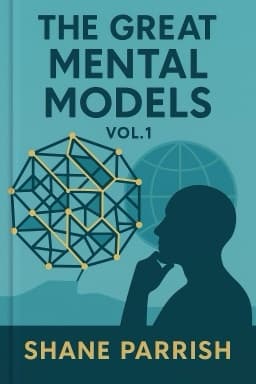
Sources: The Great Mental Models by Shane Parrish, Farnam Street insights, Acquirers Multiple reviews, Goodreads community reflections.
Want to explore more insights from this book?
Read the full book summary