
Why Most People Fail to Think Clearly (And How Mental Models Save You)
Uncover the hidden traps in your thinking and learn how mental models provide a roadmap to intellectual clarity.

Have you ever made a decision that, in hindsight, seems baffling? Maybe you ignored warning signs, trusted the wrong advice, or fell prey to a gut feeling that led you astray. The truth is, clear thinking is deceptively difficult. Our brains are wired with shortcuts and biases that often mislead us.
One major culprit is overconfidence—believing we know more than we do. This illusion pushes people beyond their circle of competence, leading to mistakes. For example, investors who chase hot stocks without understanding the business often lose money. Recognizing your knowledge boundaries is a crucial first step toward better decisions.
Confirmation bias tempts us to seek information that supports our beliefs while ignoring contradictory evidence. This mental trap narrows perspective and reinforces errors. Mental models act as cognitive checklists, prompting us to question assumptions and explore alternative explanations.
Short-term thinking focuses on immediate rewards at the expense of long-term consequences. The British cobra bounty program, which unintentionally encouraged breeding cobras, is a classic example of ignoring second-order effects. By adopting second-order thinking, we learn to anticipate ripple effects and avoid unintended harm.
Uncertainty often paralyzes decision-making. Probabilistic thinking, especially Bayesian updating, teaches us to embrace uncertainty by continuously refining beliefs based on new evidence. Understanding fat-tailed risks prepares us for rare but devastating events, helping us build resilience.
Finally, social misunderstandings arise when we assume malice instead of error. Hanlon’s Razor encourages compassion and clearer judgment, reducing conflict and paranoia.
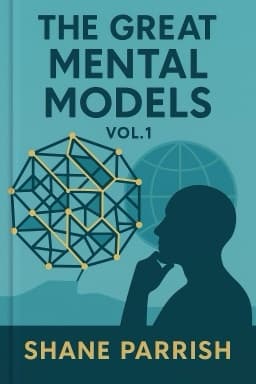
By integrating these mental models into a latticework, we create a robust framework for navigating complexity. This interconnected approach reduces blind spots and equips us to think clearly, creatively, and confidently.
Start today by questioning your assumptions, embracing uncertainty, and building your latticework of mental models.
Sources: Farnam Street, The Great Mental Models, Reddit mental models community, Acquirers Multiple insights.
Want to explore more insights from this book?
Read the full book summary