
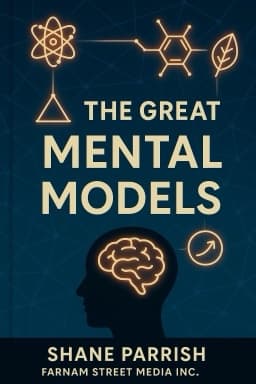
Think Like a Genius: Mastering ‘The Great Mental Models’ to Outsmart Complexity
Learn how to use mental models to break down complexity and make smarter decisions

Complexity is the defining challenge of our time. Whether in business, science, or daily life, problems rarely have simple solutions. Shane Parrish’s The Great Mental Models provides a roadmap for navigating this complexity by equipping you with powerful cognitive frameworks.
The first step is understanding perspective: realizing that reality looks different depending on your vantage point. This insight helps you avoid blind spots and appreciate alternative views.
Next, reciprocity teaches that actions have equal and opposite reactions, a principle that applies from physics to human relationships. Recognizing this helps you anticipate consequences and foster cooperation.
Energy and entropy models reveal why systems tend toward disorder without input and why maintaining order requires effort. This knowledge informs strategies for sustaining organizations, projects, and personal habits.
Inertia and friction explain why change is difficult and how resistance can be managed. These models guide you in overcoming obstacles and accelerating progress.
Velocity combines speed with direction, emphasizing purposeful action. Leverage shows how to amplify your efforts through strategic positioning, turning small inputs into large outcomes.
By weaving these models into a latticework, you create a flexible mental toolkit that enhances problem-solving, decision-making, and innovation. This approach not only helps you outthink complexity but also builds resilience and adaptability.
Mastering these mental models is like gaining the cognitive habits of geniuses — seeing patterns others miss and acting with clarity and confidence.
Sources: Goodreads reviews, Blinkist summaries, Toby Sinclair’s insights, Reddit community discussions 2 1 3 4
Want to explore more insights from this book?
Read the full book summary