
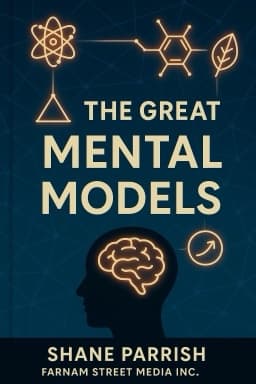
Unlock Your Brain’s Hidden Power: The Ultimate Guide to ‘The Great Mental Models’
Discover how mastering mental models can revolutionize your thinking and life decisions

Have you ever wondered why some people seem to make better decisions effortlessly, while others struggle with even simple choices? The secret often lies not in IQ but in the mental models they use — the frameworks and lenses through which they interpret the world. Shane Parrish’s book series The Great Mental Models offers a comprehensive roadmap to mastering these tools, empowering you to think better, faster, and more creatively.
Imagine your mind as a latticework of interconnected ideas, each mental model a node that helps you simplify complexity. The book begins by challenging our assumptions about perspective, illustrating through Galileo’s ship and Einstein’s lightning thought experiments how our understanding of reality depends on the observer’s frame of reference. This foundational insight encourages empathy and flexibility, reminding us that no single viewpoint holds the whole truth.
Next, the principle of reciprocity extends beyond physics’ Newton’s Third Law to human relationships. Giving and receiving, action and reaction, form the basis of trust and cooperation. This model reveals why kindness often returns in unexpected ways and why social harmony depends on mutual benefit.
Energy conservation and entropy introduce us to the laws of thermodynamics, showing how order requires constant effort against the natural drift toward disorder. The book ties these physical laws to social constructs like walls and borders, highlighting the challenges of maintaining separation in dynamic systems.
Inertia explains our resistance to change, whether in habits, beliefs, or societal norms. Historical examples like the slow phase-out of lead versus the rapid ban of absinthe illustrate how mass and momentum affect the pace of transformation.
Friction and viscosity represent invisible forces that slow progress. From physics to organizational communication, reducing resistance can unleash innovation and efficiency, as seen in Toyota’s lean manufacturing and the tragic consequences of Soviet-era information bottlenecks.
Velocity ties speed to direction, emphasizing that fast movement is meaningless without purposeful goals. Napoleon’s military campaigns exemplify how strategic velocity outperforms mere speed.
Finally, leverage teaches us to amplify impact with less effort, whether through physical tools like levers or metaphorical strategies like political alliances. Eleanor of Aquitaine’s story illustrates how positioning and relationships multiply power.
By integrating these models into a coherent latticework, we gain a flexible, interdisciplinary toolkit for better thinking. This approach helps us navigate complexity, avoid common cognitive traps, and make wiser, more effective decisions.
In a world overwhelmed by information and uncertainty, mastering mental models is not just an intellectual exercise but a practical necessity. As Farnam Street wisely puts it, “The quality of your thinking depends on the models that are in your head.” Equip yourself with these timeless frameworks and unlock your brain’s hidden power today.
Sources: Blinkist summary of The Great Mental Models Volume 4, Goodreads reviews, Toby Sinclair’s book summary, Reddit book review community 1 2 3 4
Want to explore more insights from this book?
Read the full book summary