
How Your Brain Tricks You Daily: The Hidden Biases Controlling Your Life
Unmasking the unconscious forces that steer your decisions and shape your reality.

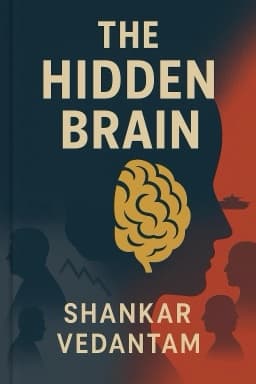
Every day, your brain is performing a complex dance behind the scenes, processing information, making judgments, and guiding behaviors — all without your conscious awareness. This hidden brain, as explored in Shankar Vedantam’s illuminating work, is responsible for many of the quirks, errors, and shortcuts that define human experience.
Consider the phenomenon of unconscious mimicry: when a waitress subtly matches a customer’s speech rhythm, the customer tips significantly more. This is no coincidence but an automatic social bonding mechanism hardwired into our brains to foster trust and cooperation.
Or think about how the mere presence of watching eyes — even images — can dramatically increase honest behavior. This unconscious sensitivity to social surveillance reflects our deep need for social acceptance and reputation management.
However, these mental shortcuts, or heuristics, can lead us astray. Stocks with easy-to-pronounce names often outperform initially because investors feel more comfortable with them, despite no difference in fundamentals. This 'pronounceability bias' illustrates how surface-level features can sway important economic decisions.
Our hidden brain also plays a crucial role in forming social biases from infancy. Babies’ preference for faces helps them bond with caregivers, but as they grow, cultural patterns imprint unconscious racial biases. Preschoolers, for example, already associate positive traits with their own race and negative traits with others, even without explicit teaching.
Gender bias is another domain shaped by unconscious processes. Women leaders face a double bind — expected to be both competent and likable — a paradox fueled by implicit stereotypes. Wage disparities, like those highlighted in the Lilly Ledbetter case, persist partly because of these hidden biases.
In crisis situations, the hidden brain’s drive for conformity can delay life-saving actions. The bystander effect shows how individuals defer responsibility, expecting others to intervene. Understanding these unconscious group dynamics can inform better emergency response training.
The justice system too is influenced by hidden biases. Defendants with stereotypical features often receive harsher sentences due to unconscious associations of criminality. Eyewitness testimony, a critical evidence source, is vulnerable to memory distortions shaped by bias, leading to wrongful convictions.
Politics provides a vivid example of the hidden brain’s power. Voters’ unconscious racial biases predict candidate support beyond conscious beliefs. Political messaging often uses coded language to activate these biases subtly, influencing elections without overt appeals.
Recognizing these hidden forces allows us to question our assumptions and biases, improving decision-making and social harmony. By shining light on the unconscious, we can foster empathy and create environments that mitigate bias and promote fairness.
Ultimately, the hidden brain teaches us humility about our own minds and offers pathways to greater awareness and growth.
Sources: Based on insights from Shankar Vedantam’s book and supported by social science literature and expert reviews. 1 3 4
Want to explore more insights from this book?
Read the full book summary