
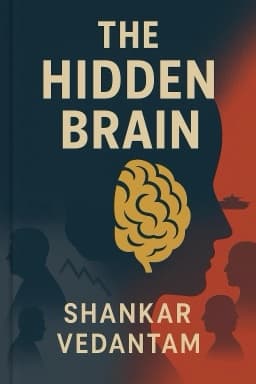
Unlocking the Secrets of Your Mind: How 'The Hidden Brain' Explains Your Everyday Decisions
Discover the unseen forces that shape your thoughts, choices, and actions every day.

Have you ever wondered why you sometimes act against your own best interests or why your gut feeling often contradicts your conscious reasoning? The answer lies in the fascinating world of the hidden brain — the vast realm of unconscious mental activity that shapes our behavior without us realizing it. In his groundbreaking book, Shankar Vedantam takes us on a captivating journey through this unseen landscape, revealing how much of our lives are governed by forces outside our conscious awareness.
One of the most striking insights from the book is how unconscious biases influence seemingly straightforward decisions. For example, in an office where employees pay for coffee on an honor system, simply replacing a picture of flowers with an image of watching eyes caused the amount collected to increase sevenfold. This experiment demonstrates how subtle social cues, even when unnoticed, can dramatically affect honesty and cooperation.
Similarly, our preferences and judgments are shaped by heuristics — mental shortcuts that help us navigate complexity but can also mislead us. Stocks with easy-to-pronounce names tend to perform better initially because investors unconsciously associate pronounceability with safety. These hidden biases operate silently, guiding economic and social outcomes in profound ways.
Our social behavior is also governed by unconscious mimicry. When a waitress subtly mirrors her customers’ speech patterns, those customers tip significantly more. This mimicry fosters connection and trust without any conscious effort, highlighting how the hidden brain facilitates social bonding.
But the hidden brain is not infallible. Mental disorders such as frontotemporal dementia reveal how unconscious brain systems regulate social norms and morality. Patients with this condition lose the ability to read social cues and inhibit inappropriate behavior despite intact reasoning skills. This dissociation underscores the vital role of unconscious processes in ethical conduct.
From infancy, unconscious biases shape our perceptions of race and social groups. Babies prefer faces and eyes instinctively, forming attachments crucial for survival. Yet, preschool children already associate positive traits with their own race and negative traits with others, illustrating how cultural patterns embed in the hidden brain early on.
Gender and privilege are similarly influenced by invisible biases. Women leaders face a double bind, judged both on competence and likability, while wage disparities persist due to unconscious assumptions. The landmark Lilly Ledbetter case brought these issues to light, demonstrating the real-world impact of hidden biases on equality.
In moments of crisis, conformity driven by the hidden brain can be both protective and dangerous. The bystander effect — where people assume others will act — delays intervention during emergencies. Understanding these unconscious group dynamics can help design better training and leadership to save lives.
The legal system is not immune. Unconscious racial biases affect sentencing and jury decisions, with defendants exhibiting stereotypical features receiving harsher punishments. Eyewitness misidentification, influenced by bias, leads to wrongful convictions, challenging our notions of justice.
Finally, politics is deeply shaped by the hidden brain. Voters’ unconscious racial biases influence candidate support beyond explicit beliefs. Political campaigns use coded language to trigger these biases subtly, affecting opinions and turnout without overt references.
Understanding the hidden brain reveals that much of what governs our lives operates beyond conscious control. By bringing these forces into awareness, we gain tools for greater self-understanding, empathy, and social change. This knowledge invites us to question our assumptions, challenge bias, and build a more just and connected world.
For those fascinated by psychology, social behavior, and the mysteries of the mind, ‘The Hidden Brain’ offers a compelling lens through which to view human nature — a journey worth taking.
References: Insights and examples drawn from Shankar Vedantam's 'The Hidden Brain' and corroborated by critical reviews and social psychology research. 1 2 3
Want to explore more insights from this book?
Read the full book summary